



LeBron bringing Bronny back to the Cavaliers? US media proposes a three-team blockbuster: Lakers to receive two All-Stars



On January 28th Beijing time, reporter Shams previously indicated that LeBron’s tenure with the Lakers is almost over. Multiple media sources suggest that if he opts not to retire, returning to his hometown team, the Cavaliers, would be the most fitting choice.The prominent US media Bleacher Report has presented a three-way trade proposal that would send LeBron and his son to the Cavaliers, considering it a truly viable transaction.Here is Bleacher Report’s detailed analysis—
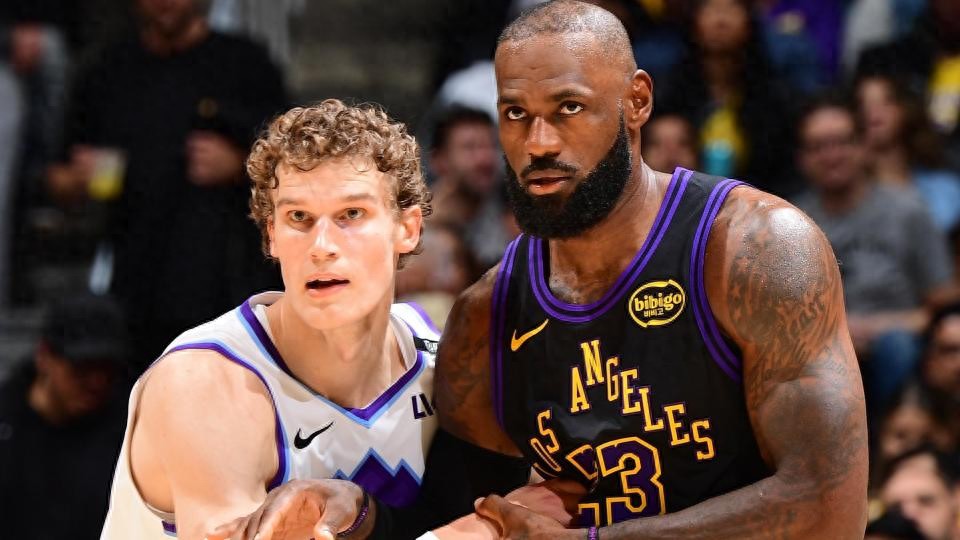
The “Lord of the Rings” trilogy, “The Dark Knight” trilogy, and “The Godfather” trilogy are cinematic legends. Could LeBron and the Cleveland Cavaliers become the newest and greatest “trilogy” legend in sports?
Reports say Lakers owner Jeanie is troubled over LeBron’s future — as the free agency market approaches, his future with the Lakers grows uncertain. For all parties, is parting ways the best option? LeBron himself has not clearly stated whether he intends to finish the season with the Lakers.
However, LeBron holds a no-trade clause, meaning any potential new team must be a championship contender and must not jeopardize the legacy he has worked hard to build. The Cleveland Cavaliers perfectly meet these two criteria.
The issue is that the Cavaliers’ front office is bound by the second luxury tax apron rules. To acquire LeBron, the team must clear significant salary cap space, which means a third team must be involved in the trade.
Let’s imagine this scenario: the Cavaliers can acquire LeBron without trading away Mitchell, Mobley, or Garland; the Lakers receive two former All-Stars; and the third team, the Jazz, gain valuable players, draft picks, and relieve future salary burdens.
This is the truly feasible trade proposal involving LeBron.
Complete trade details—
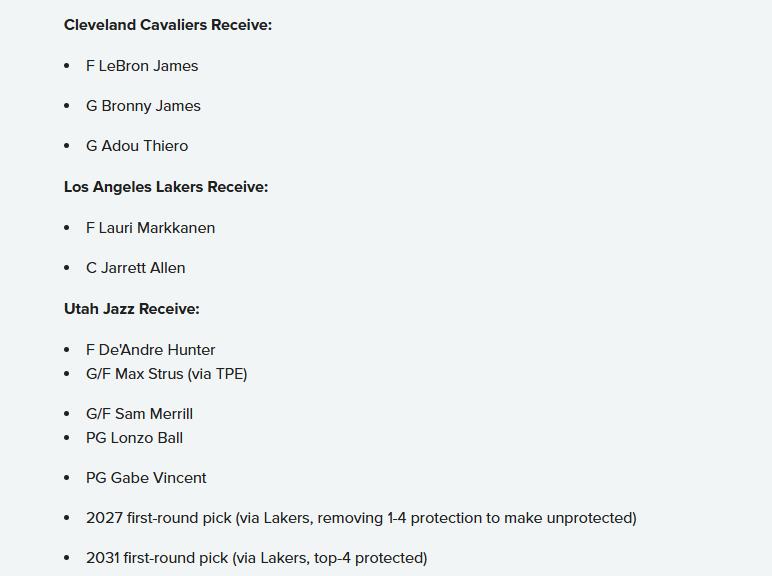
Cavaliers receive: LeBron, Bronny, Tiago
Lakers receive: Lauri Markkanen, Jarrett Allen
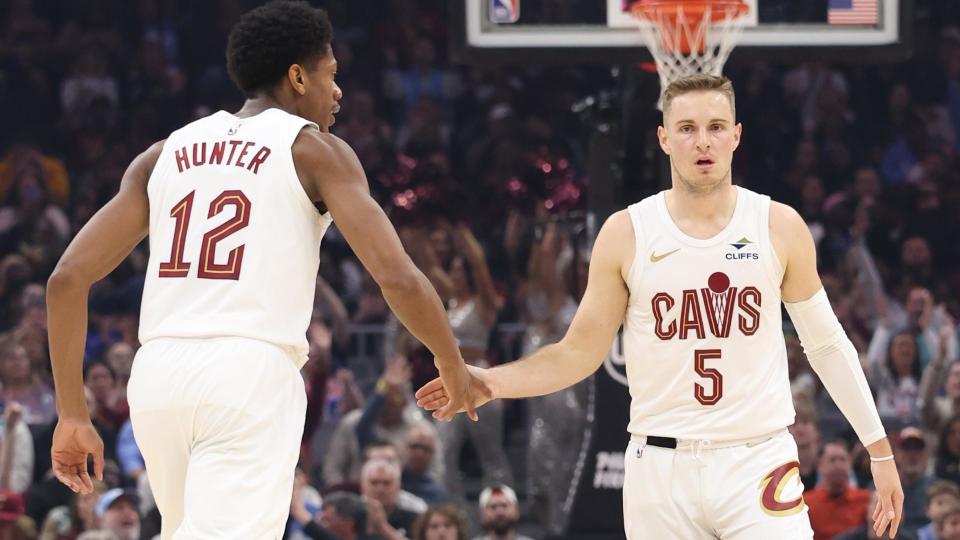
Jazz receive: Hunter, Strus, Merrill, Lonzo Ball, Vincent, Lakers 2027 first-round pick (top-4 protection removed, now unprotected), Lakers 2031 first-round pick (top-4 protection)
Why would the Cavaliers make this trade?
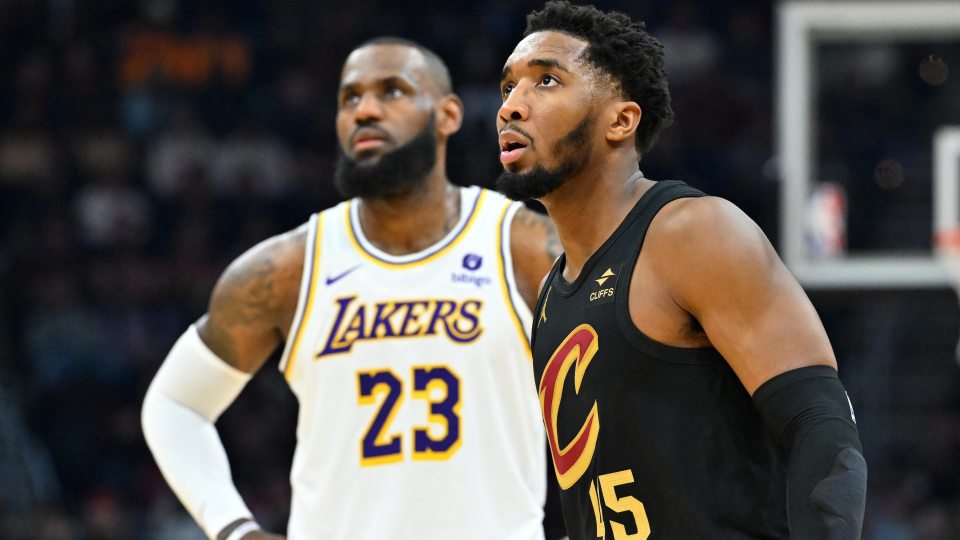
The current Cavaliers no longer need LeBron to arrive as a “savior.” However, the team’s mediocre performance this season calls for a boost. With a 27-20 record, they sit fifth in the highly competitive Eastern Conference, falling far short of preseason expectations to lead the East.
If they can keep their core trio Mitchell, Mobley, and Garland while adding LeBron — who this month averages 24.8 points, 7.5 rebounds, 7.3 assists, and 1.2 steals on 52.1% shooting — the Cavaliers should definitely push hard for this deal.
The Cavaliers have exited the playoffs early for three consecutive years, and LeBron can bring the toughness and playoff experience they desperately need. There is also a sentimental factor: as LeBron’s legendary career nears its end, returning home is a deeply touching move. Moreover, at 41, he still has the ability to help the Cavaliers compete for a championship — exactly ten years since he led them to their first-ever title in 2016.
After the trade, the Cavaliers could start Garland, Mitchell, Dean Wade, LeBron, and Mobley, with strong bench players like second-year standout Jalen Tyson, along with Larry Nance Jr., Craig Porter Jr., Taris Proctor, and Thomas Bryant. The team needs to fill two roster spots while keeping salaries below the second luxury tax apron, likely by converting two-way contracts like Tomlin and Livingston into fully guaranteed deals.
Although team depth will be somewhat affected, the Jazz must waive two players to complete the trade, which opens the door for the Cavaliers to bring back Kevin Love or Georges Niang.
One often overlooked benefit of this trade is that the Cavaliers would not only escape the second luxury tax apron but also save over $100 million in salary and luxury tax payments this season alone. LeBron’s $52.6 million contract expires this summer, and he is very likely to sign a one-year, team-friendly deal with the Cavaliers to start the final chapter of his championship pursuit in his hometown.
In summary, the Cavaliers keep their three All-Stars, bring back LeBron to chase a title, shed the luxury tax constraints, and gain ample salary cap flexibility this summer.
Why would the Lakers agree to this trade?
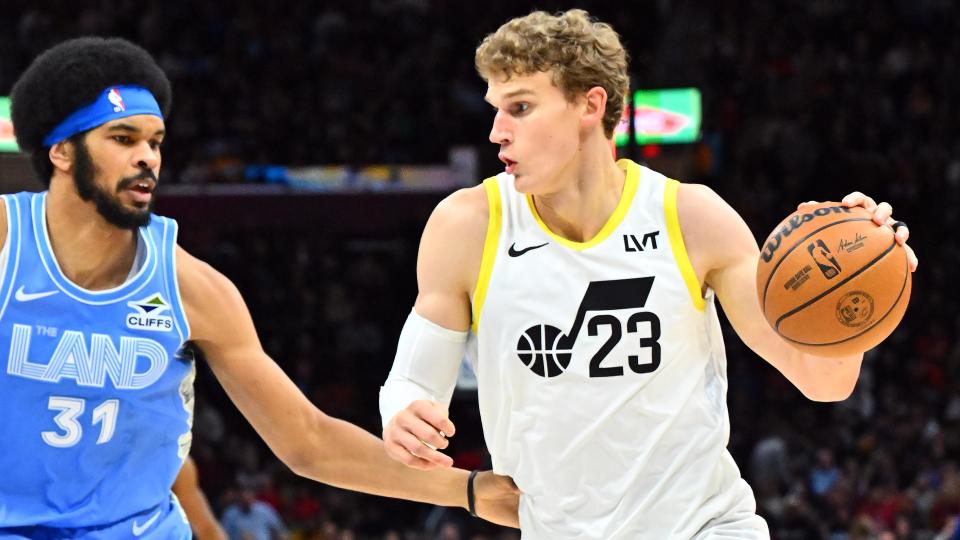
Even in his 23rd NBA season, LeBron remains highly productive, but the Lakers’ future building must focus on Luka Dončić.
This season’s data shows that when Dončić and LeBron share the floor, the Lakers’ net rating is -2.4; when Dončić plays alone, it jumps to +4.4. In a few months, LeBron will become a full free agent, and his career is winding down. The Lakers must act quickly to leverage his contract for a new All-Star partner, or they will regret missing the opportunity.
Markkanen has had a phenomenal season with the Jazz, averaging 27.9 points (9th in the league), 7.2 rebounds, 2.2 assists, and 1.0 steals, shooting 56.3% on twos and 36.5% on threes. This 7-foot forward boasts a plus-minus of +16.9, ranking in the top 2% of the league.
At 28 years old, Markkanen perfectly matches the ages of Dončić (turning 27), Austin Reaves (27), and Jarrett Allen (27). This core group ensures the Lakers remain competitive for years to come.
If the Lakers do not plan to re-sign Deandre Ayton after this season (he has a $8.1 million player option for 2026-27), then Allen is the ideal frontcourt partner for Dončić — capable of rim protection and finishing plays. Allen is about to begin a cost-effective three-year extension worth $90.7 million, with a starting salary of $28 million next season.
In this trade, the Lakers acquire the highest-value player, Markkanen, paying only a new first-round pick and converting the previously protected 2027 first-round pick owed to the Jazz into an unprotected one. Notably, both Markkanen and Allen are former All-Stars.
Why would the Jazz agree to this trade?
This season, even with a “strategic tanking” approach resting key players, the Jazz’s record of 15-31 is not bad enough, failing to rank among the league’s bottom five. It’s important to note that if the Jazz’s draft pick ends up ninth or later, it will belong to the Thunder. Therefore, the Jazz must secure a top-eight pick.
What’s the easiest way to achieve this? Trade the team’s star player.
Thanks to Markkanen’s breakout performance this season, his trade value is at its peak. The Jazz should seize this chance to trade him for draft picks, expiring contracts, and players who can be flipped in future deals.
Post-trade, the Jazz’s previously top-4 protected 2027 Lakers first-round pick becomes fully unprotected; they also receive the 2031 first-round pick (top-4 protection), which will materialize when Dončić is 32 years old.
Vincent (earning $11.5 million) and Lonzo Ball (with a $10 million team option for 2026-27) together represent $21.5 million in contracts, roughly equivalent to expiring deals, freeing up cap space for the Jazz this summer to offer a new contract to Kessler.
Hunter (13.8 PPG), Merrill (13.8 PPG, 45.5% from three), and Strus (last season 9.4 PPG, 38.6% from three) could immediately be traded to contenders, attracting interest both before the trade deadline and this summer.
In conclusion, this trade helps the Jazz secure a top-eight pick in the 2026 draft, gain valuable draft assets, free over $20 million in cap space, and acquire three veteran forwards with trade value. Assuming Vincent and Ball are waived, the Jazz would still need to cut two more players. Kevin Love, Georges Niang, and Lee Kyle are the most likely candidates, as their contracts expire at the end of this season.


Wonderfulshortvideo
Jaxson Hayes really brought out the eastbay slam 😱


Just like practice! 🤣🏀
Luka went OFF for 46 points in win over the Bulls 🔥
KD with the slam inside 💥
Replying to @NBA Luka so happy to have his teammate Jaxson Hayes 😅
LeBron gets the steal and throws down the monster slam 😤
LeBron is COOKING 🔥
 Links
Links
 Contact
Address:UNIT 1804 SOUTH BANK TOWER, 55 UPPER GROUND,LONDON ENGLAND SE1 9E
Number:+85259695367
E-mali:[email protected]
 App
App


