



NBA three-team trade ratings released! Bulls rated A, Cavaliers B+, Kings acquiring Hunter rated only C



On February 1st Beijing time, according to renowned reporter Shams, the Cavaliers, Kings, and Bulls finalized a three-team trade, with the details as follows —
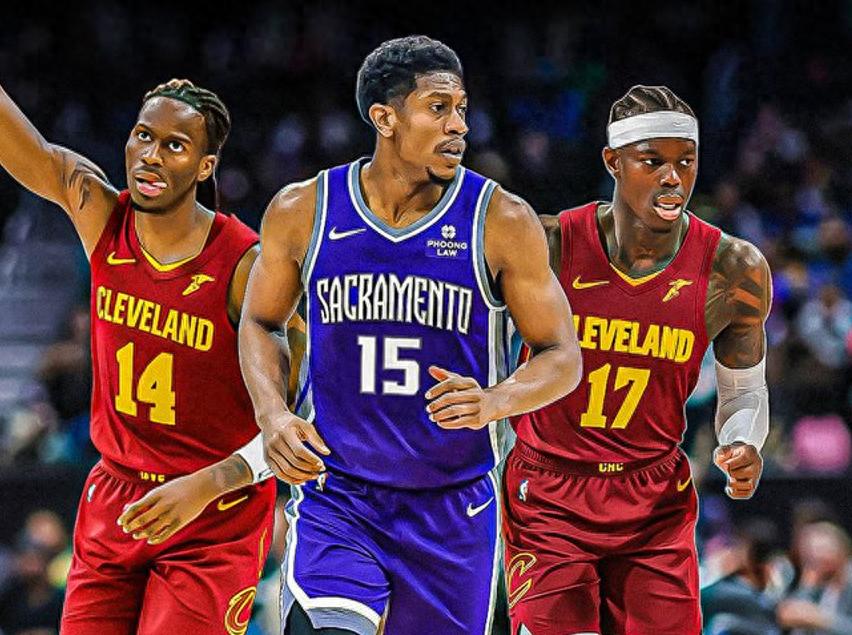
Cavaliers receive: Dennis Schröder, Keon Ellis
Kings receive: Forward De'Andre Hunter
Bulls receive: Forward Dario Šarić, two future second-round draft picks
Note: The two second-round picks the Bulls acquired come from the Cavaliers and Kings. The Cavaliers' pick is a 2027 second-rounder (acquired via the Denver Nuggets), and the Kings' pick is a 2029 second-rounder (the lowest among the Pistons, Bucks, and Knicks). The Bulls waived Javon Carter to make room for Šarić.
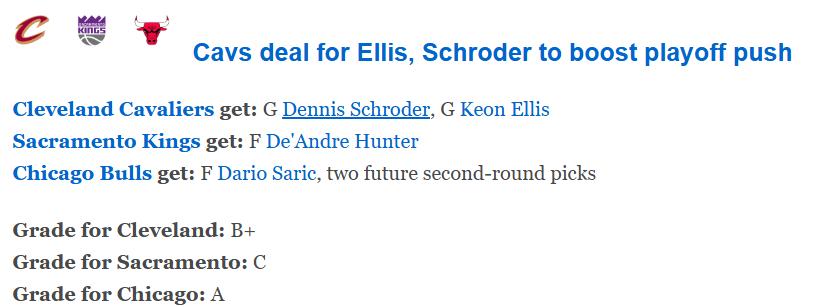
Subsequently, ESPN rated the trade: Bulls received an A, Cavaliers a B+, and the Kings the lowest rating of C. Below is the detailed analysis —
Cavaliers trade rating: B+
Although his playing time this season has declined compared to last year, Ellis, on a minimum salary contract with 3-and-D skills suitable for a championship contender, surprisingly became one of the most sought-after players before the trade deadline. His reduced role partly stems from a drop in shooting efficiency: last season, his effective field goal percentage including three-point value was 64%, but this season his three-point shooting fell to 37%, and two-point shooting to only 46%, both career lows for a full season (in 2022-23, as a two-way contract rookie, he only played 71 minutes).

Looking at his career overall, Ellis has a three-point shooting percentage of 42%, two-point shooting of 56.5%, and an effective field goal percentage of 61%, making him one of the most efficient perimeter role players in the league. This 1.93m guard has the size to defend both backcourt positions and excels in on-ball defense due to his agility — according to Genius IQ tracking, 24% of his defensive possessions this season were guarding opposing ball handlers.
The pairing of Ellis with Mitchell is promising: due to Garland’s toe injury, Mitchell has spent almost equal time as a ball-handler and off-ball player this season. In such a lineup, Ellis can relieve Mitchell’s ball-defense burden and also stretch the floor offensively. In contrast, Schröder’s fit remains uncertain, especially if Garland returns healthy — the Cavaliers’ backcourt already includes All-Stars Garland and Mitchell, sharpshooter Merril, dependable backup point guard Craig Porter, and veteran Ball. Even though Schröder lost his starting role on the Kings to Westbrook, he still averaged 26.4 minutes per game, but his playing time with the Cavaliers will likely shrink significantly.
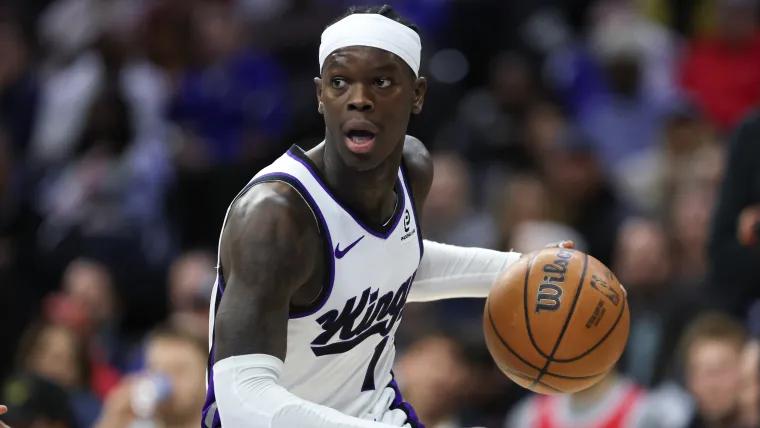
From a financial perspective, the Cavaliers drastically reduced luxury tax expenses, saving nearly $40 million in luxury tax simply by sending Šarić to the Bulls. More importantly, the team is close to dropping below the second luxury tax threshold, creating the necessary conditions for salary cap maneuvers before the deadline. Previously, to achieve this, the Cavaliers might have needed to clear Hunter’s full $23.3 million contract, which was too large for other teams’ salary cap or trade exceptions. Now, after cutting nearly $7 million in salary through this trade, the Cavaliers only need to trade Schröder ($14.1 million) or Strus ($15.9 million) without taking back salary to get below the second luxury tax line, giving them more flexibility to pursue star players.
Looking ahead, if the Cavaliers re-sign Ellis, salary pressure could increase further. Schröder’s 2026-27 salary is $10 million less than Hunter’s, but that difference might not cover Ellis’s starting salary on a new contract or his potential fully guaranteed deal as a free agent. Salary expert Max revealed Schröder’s 2027-28 salary includes $4.35 million guaranteed, while Hunter’s contract expires next summer. However, these are issues to consider later.
The most realistic way for the Cavaliers to save money remains hoping Mitchell opts out of his $53.8 million player option in 2027 to become a full free agent — but this is exactly what the team wants to avoid. The Cavaliers finished first in the Eastern Conference last season and are currently tied for fourth this season; strengthening the roster is the best way to retain Mitchell. This trade is an important step in that direction and may lay the groundwork for bigger moves before the deadline.
Kings trade rating: C

This trade harshly exposed the Kings’ poor decisions last summer. As new GM Scott Perry said last month, the team initially aimed for a playoff push but later shifted focus to building a more sustainable roster.
To acquire Schröder as a true free agent via sign-and-trade while avoiding luxury tax penalties, the Kings had to cut salary, trading Valančiūnas to the Denver Nuggets in exchange for Šarić. However, this move backfired — Valančiūnas later expressed his desire to waive his contract and join Greek powerhouse Panathinaikos (though the Nuggets ultimately declined his request).
In the end, Šarić only played 5 games for the Kings, and Schröder started just twice after November 12th (ironically, those two games were his last with the Kings, as Westbrook was sidelined with a foot contusion).
The Kings exchanged these two new players for Hunter, also giving up second-round draft picks.
On the positive side, the Kings acquired Hunter at a low point in his value. A year ago, the Cavaliers gave up three second-round picks and two first-round swap rights to get him during their playoff push. At that time, Hunter’s three-point shooting was a career-high 39%, and after joining the Cavaliers, his form improved further with a 46% three-point rate in the playoffs. This season, however, his three-point shooting dropped to a career-low 31%, and his average playing time in January fell to 22.4 minutes per game.
As a career 37% three-point shooter, Hunter should regain more consistent shooting with the Kings, and his ability to play both forward positions fits well with their frontcourt size issues. Taking on his $24.9 million salary for the 2026-27 season will trigger luxury tax for the Kings, but the team has ample time to adjust their salary structure beforehand. In the worst case, DeMar DeRozan’s partially guaranteed $10 million salary can help the Kings safely drop below the luxury tax threshold.
If Hunter performs up to expectations, he could still become a trade target for championship contenders before next year’s deadline.
Bulls trade rating: A
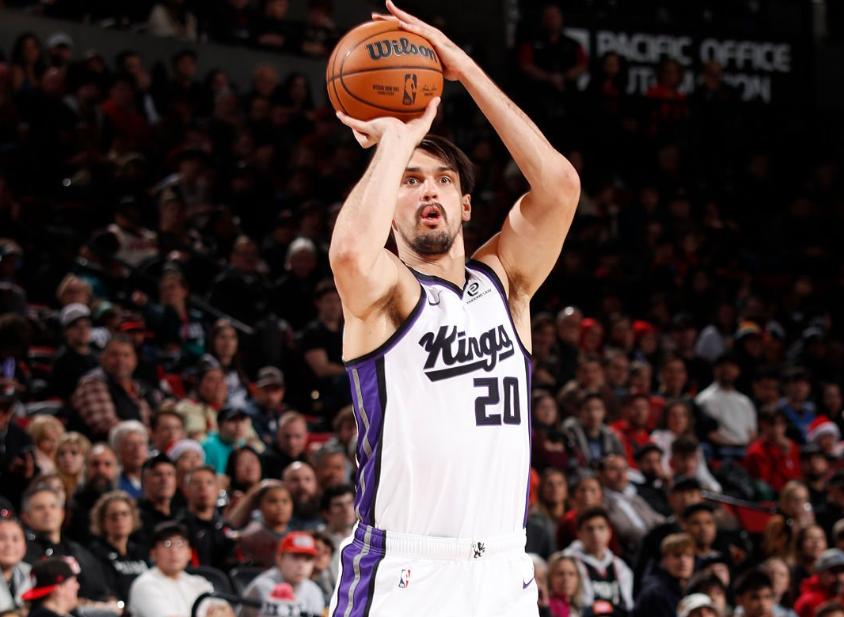
The Bulls showed wisdom by seizing the opportunity that required a third team to absorb Šarić’s salary. In 2024, the Bulls, Kings, and Spurs completed a three-team trade sending DeRozan to the Kings and Harrison Barnes to the Spurs, but the Bulls’ precarious luxury tax situation at that time caused them to miss out on the most valuable draft asset — the Spurs’ 2031 first-round swap right gained by taking on Barnes’s salary.
This season, the Bulls’ salary total is over $13 million below the luxury tax threshold, allowing them to use the remaining trade exception from another Bulls-Kings-Spurs three-team trade (which a year ago sent LaVine to the Kings) to absorb Šarić’s $5.4 million salary.
The Bulls waived Javon Carter to free up a roster spot for Šarić. If Šarić is not included in any further trades, he will likely be bought out after the deadline, allowing the Bulls to easily gain two additional second-round draft picks.


Wonderfulshortvideo
Who’s the most famous person in Snoop’s phone?


"It's the shhh with a hyphen." More Slovenian lessons 😂
Jaxson Hayes really brought out the eastbay slam 😱
Short… SIKE
What a FANTASTIC FINISH by the @Phoenix Suns 🤩
This was too tough 💪 💥
Wemby drains the tough middy 🔥
 Links
Links
 Contact
Address:UNIT 1804 SOUTH BANK TOWER, 55 UPPER GROUND,LONDON ENGLAND SE1 9E
Number:+85259695367
E-mali:[email protected]
 App
App


