



Alexander: Requiring at least 65 games for award eligibility is reasonable; my health is more important than any award.



On February 28th, Beijing time, in the NBA regular season, the Thunder defeated the Nuggets 127-121 in overtime. Alexander returned to action in this game, contributing 36 points, 3 rebounds, 9 assists, 2 steals, and 2 blocks. After the game, he spoke with the media—
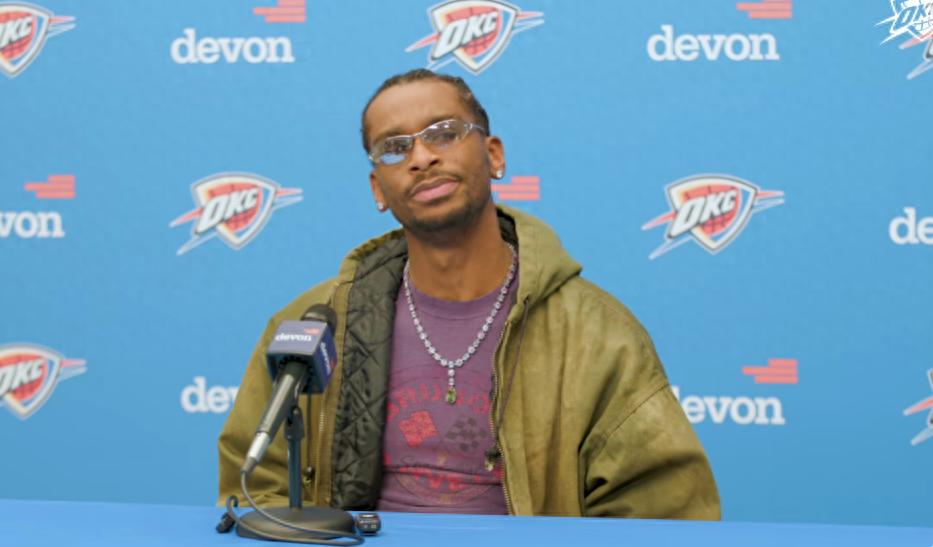
Reporter: What are your thoughts on the team's competitive intensity tonight and their performance down the stretch?
Alexander: Outstanding. Over the past few weeks, many players have been out, but the team has continued to play exceptionally well. Our three primary ball-handlers have been out for almost a month, which is tough—most teams couldn't handle that. But they always found ways to score and win, which is truly remarkable. I expected our defense to hold up, but scoring could have been a challenge since we had to play a style we've never used before. Yet the team adjusted on the fly incredibly well. As everyone saw, many players stepped up during this period. So it's not just tonight; the whole team has been outstanding these past few weeks, and I'm not surprised at all. Even when I and Hartenstein weren't on the floor in overtime, I was 100% confident we had a chance to win.
Reporter: Two questions. First, you're a basketball fanatic who loves the game and loves playing—how difficult was it to be sidelined? Second, did the time off allow you to reset mentally and physically to prepare for the playoff push?
Alexander: It was terrible; I hate not being able to play. I can't wait for the minutes restriction to be over. But if I got injured again, everything up to this point would be wasted—that's how I see it.
Reporter: What did you think of the physicality tonight? What about the altercation involving Dort, Jokić, and Jaylin Williams?
Alexander: The physicality was great. Both teams desperately wanted to win and were going all out. They're clearly a top team, and so are we. We've played each other many times over the years and know each other well, so the games get more intense. It's fun—that's how late-season games are, with an edge and high intensity. It's good to have a regular-season game like this. As for the altercation, I didn't see it clearly. Usually, it's just emotions flaring up on one side and then the other. Dort got ejected, but he's not that type of player; he just desperately wants to win. I didn't see exactly what happened, but it's all good.
Reporter: The coach mentioned he communicated with you before the game about the minutes restriction and also prepared for overtime in advance. How important is it for you to maintain that communication with the coach to stay rational and not impulsive?
Alexander: They had no choice but to tell me beforehand—if they had told me in the moment, I wouldn't have left the game. So communication beforehand was necessary. But again, it was the right decision. As I said, if I got injured again, all our efforts up to now would be meaningless. Health always comes first.
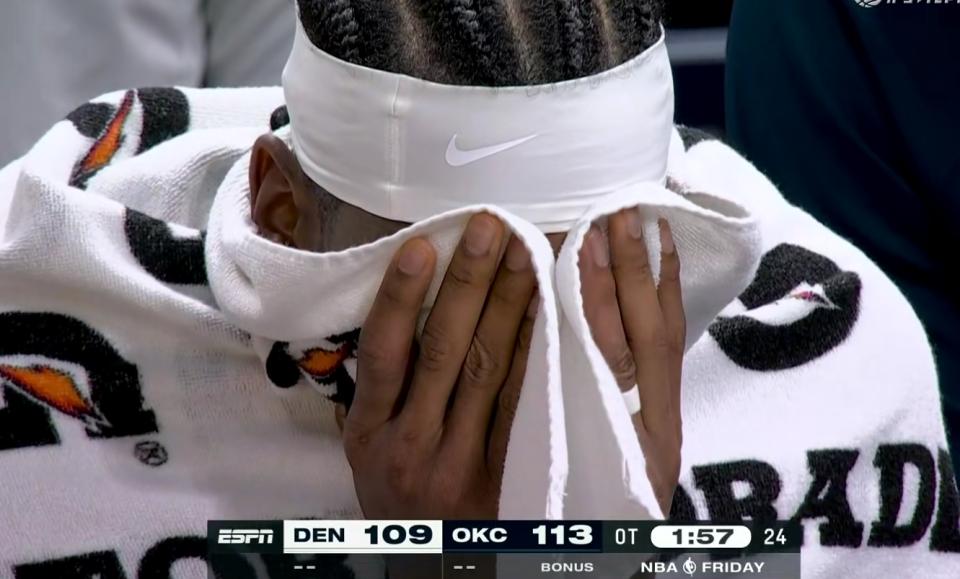
Reporter: For most of overtime, you had a towel over your face. What were you thinking? What was it like watching your teammates play?
Alexander: I just hate watching high-pressure moments when I'm not on the floor—I really do. It's not a lack of trust in my teammates; I just can't stand being off the court in those tense situations. I love it when I'm out there, but I can't handle it when I'm not. But from the possessions I did watch, the guys were phenomenal. They were scoring almost the entire overtime, making key plays, getting stops—defending like that against one of the top one or two offenses in the league is incredibly impressive and really shows our defensive level.
Reporter: There was one possession where you seemed particularly impressed by McCain. Can you talk about his pace and composure in high-intensity moments?
Alexander: He was fantastic tonight. There was a stretch where he stabilized us with his scoring—several crucial buckets and key shots, especially when the opponent built an early lead. His aggressive scoring kept us in it. Everyone saw his shooting touch, and as he gets more reps and understanding within the system, he'll only get better. This kid is very talented; if he wants to improve, his ceiling is limitless.
Reporter: When we ask the coach about Holmgren, he always says that as long as Holmgren is on the floor, he's a winner who only cares about winning. You probably feel the same, right? He could chase better stats, but he focuses entirely on defense and rim protection, not caring about scoring 30.
Alexander: That speaks volumes about his character. He's clearly a winner. From the moment he joined the team, he changed our culture and trajectory, and we've won a lot of games because of it. Often, young players get a taste of winning and then start chasing individual numbers, but he hasn't—he's stayed true to himself. His offensive game is far from finished; he'll only get better and understand the game more. He works too hard to stay stagnant. What's most admirable is his patience and understanding of his role. His all-out, extremely unselfish mindset is truly inspiring as a teammate. That's just who he is. When he's on the floor, we win—it's no coincidence, it's that simple.
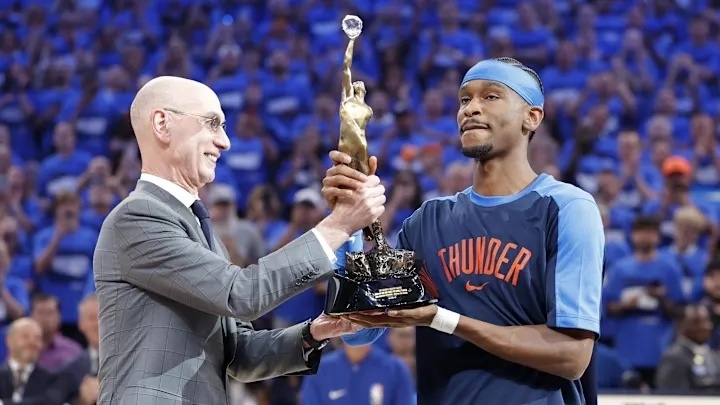
Reporter: One last question. Now that you're back, you have six games of flexibility left to reach the 65-game threshold for award eligibility. How important is that to you? What are your thoughts on the NBA's 65-game rule for awards?
Alexander: Health always comes first. If I couldn't play tonight, I wouldn't have forced it; if I can't play in the next six games, I won't push just to meet the requirement. My health is more important than any award. I don't mind the rule because historically, award winners have played the vast majority of games anyway. Whether there's a hard line or not, you typically need to play most of the games—around 65 out of 82—to win an award. I think that's reasonable, not excessive. I have no issue with it.


Wonderfulshortvideo
User ceshi has posted a video.


 Links
Links
 Contact
Address:UNIT 1804 SOUTH BANK TOWER, 55 UPPER GROUND,LONDON ENGLAND SE1 9E
Number:+85259695367
E-mali:[email protected]
 App
App


