



Over 3.45 billion euros lost in 5 seasons; injuries are the biggest “loss source” in the top five leagues



By Han Bing What is the most surprising “loss” for clubs in the Premier League and other top five leagues? It is not the loss of bonuses from missing European competitions, ticket revenue, broadcasting fees, or discounted sponsorship deals, but rather player injuries. With salaries rising sharply in recent years, especially in the Premier League, “injury costs” have become a significant financial burden for clubs. When highly paid players are sidelined by injuries, they cannot help the team win matches, qualify for European tournaments, or secure championships on the pitch, nor can they generate commercial value through outstanding performances off the pitch. For clubs, paying salaries to injured players represents an unprofitable “injury cost.”
On December 16, British company Howden Insurance released the “2024/25 European Football Injury Report.” This comprehensive 286-page report revealed the staggering “injury costs” in the top five leagues: over the past five seasons, there have been 22,596 injury incidents across these leagues, with clubs incurring a total “injury cost” of 3.446 billion euros. Injuries in Premier League clubs accounted for 24% of the total incidents, but their “injury costs” (1.379 billion euros) made up 40%, exceeding the combined totals of La Liga (601 million) and the Bundesliga (580 million).
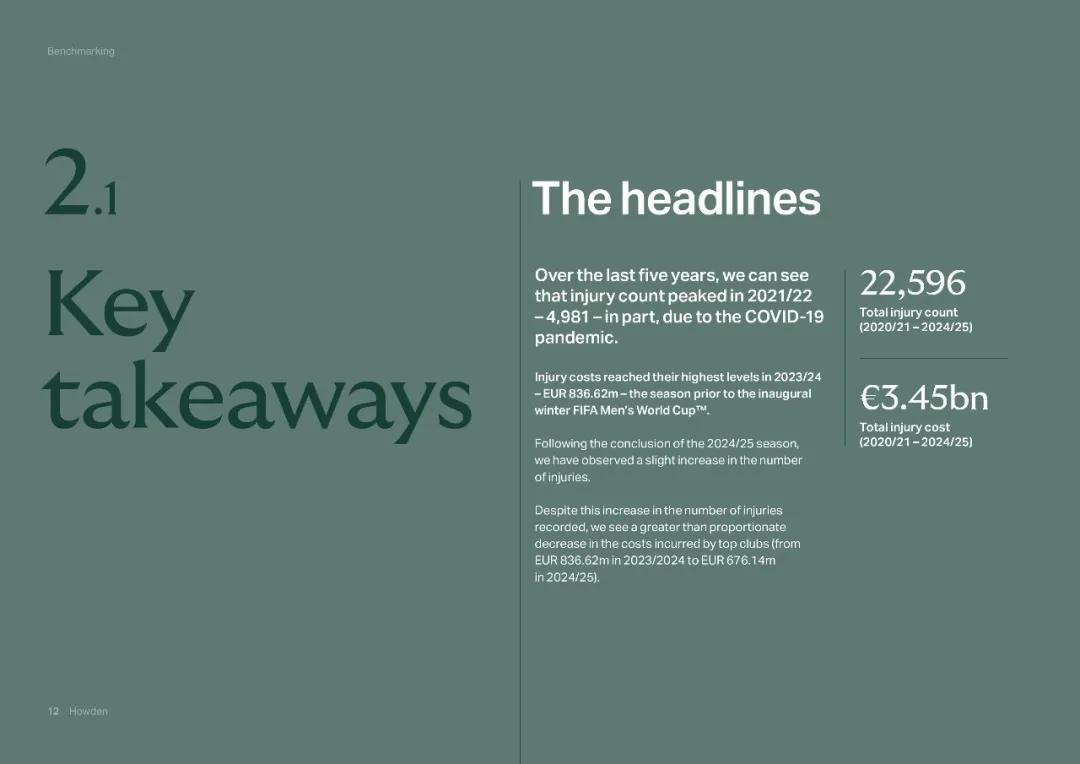
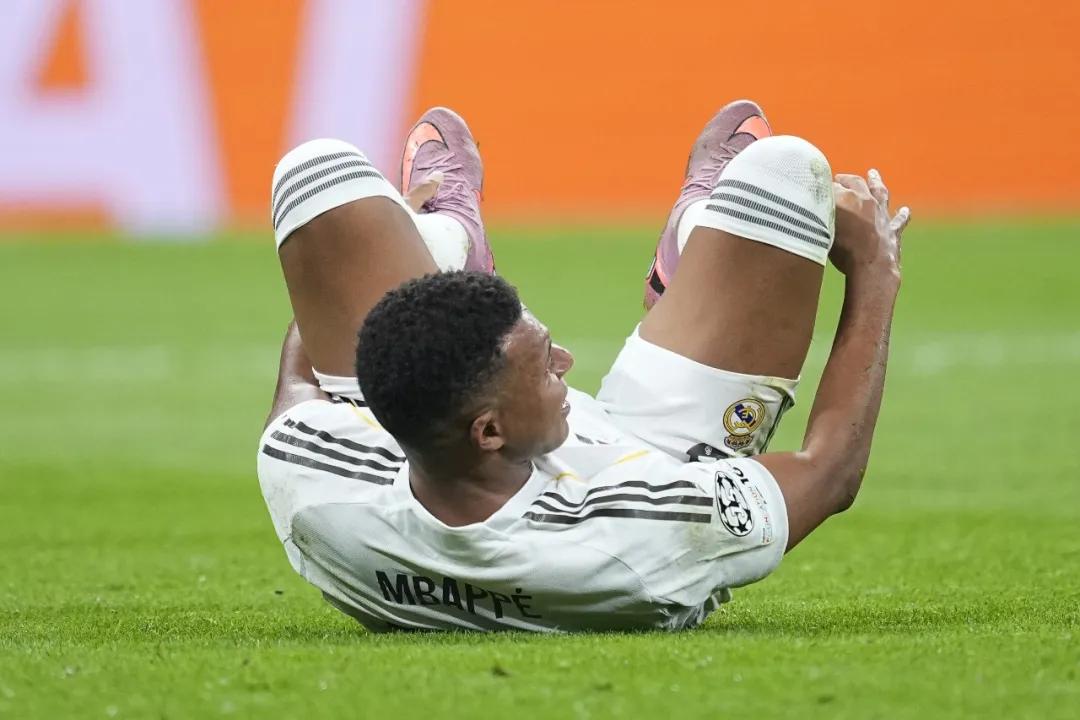
The Bundesliga recorded the highest number of injuries (6,177), but had the lowest average “injury cost” per case (90,000 euros). The Premier League, which ranks first in average salaries among the top five leagues, had the second highest injury count (5,367) and the highest average “injury cost” per player (260,000 euros), three times that of the Bundesliga and 2.5 times that of Serie A, Ligue 1, and La Liga. Chelsea, Liverpool, Manchester City, and Manchester United all exceeded the average “injury cost.” Manchester United had a total of 399 injuries and a total “injury cost” of 179 million euros over five seasons, the highest in Europe. Their single-season “injury cost” was also the highest (53.89 million), followed by Chelsea (52.22 million), PSG (51.83 million), and Real Madrid (50.29 million).
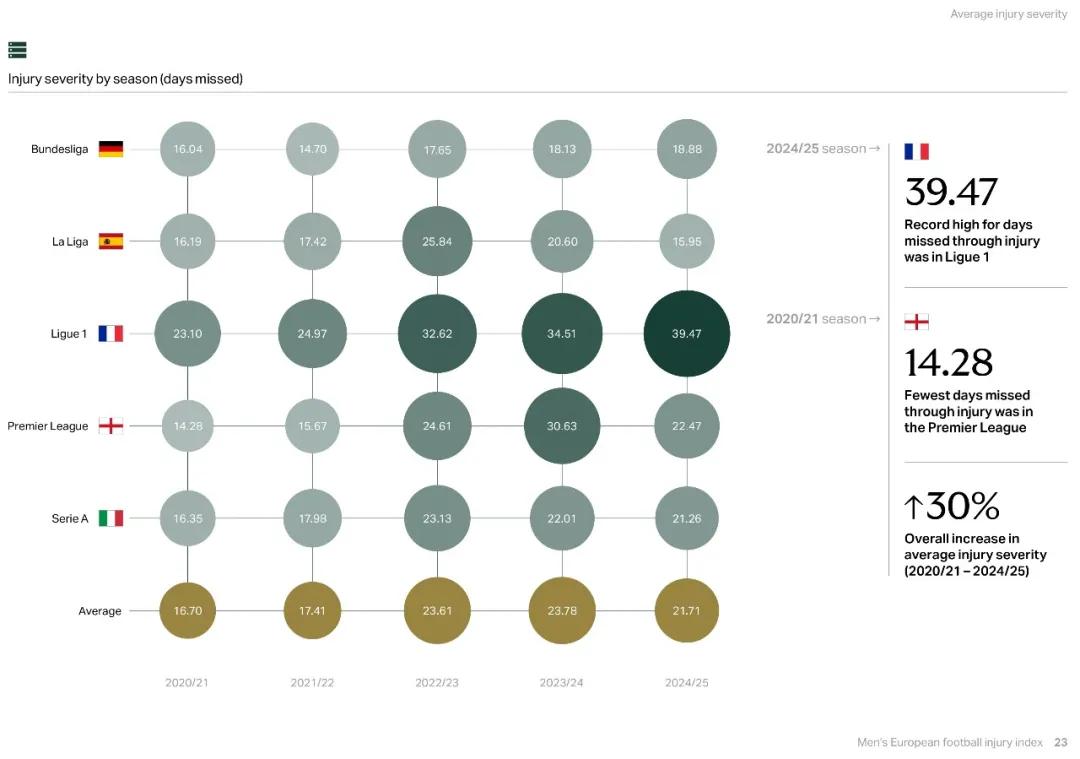
The Howden report shows that over the past five seasons, the average injury duration per season in the top five leagues has generally increased. Ligue 1 saw the steepest rise from 23.1 days to 39.47 days. The Premier League increased from 14.28 days to 22.47 days, peaking at 30.63 days in the 2023/24 season. The main cause is the increasingly congested schedules and growing number of matches over the last five seasons. Thorpe, an elite sports injury risk expert who has worked with Manchester United and the Red Bull Group, explains: “It’s logical to see a surge in injuries after major tournaments because the players involved are high-paid elites whose injuries cause huge losses both in club performance and finances.”
The COVID-19 outbreak in 2020 delayed the latter part of the season, leading to a high-density schedule in summer. This was followed by the 2021 European Championship, the 2022 World Cup, the 2024 European Championship, and the 2025 Club World Cup. The tight schedule caused a spike in injuries following major tournaments. The 2022 Qatar World Cup interrupted the traditional European season with almost no additional winter break, directly causing an increase in injury numbers and costs. In December 2022, the injury cost in the top five leagues was 50.32 million euros, which surged by 55% to 78.19 million just one month after the World Cup ended in January 2023.
The newly added Club World Cup this summer had a similar effect. Between June and July, nine top five league teams participating in the tournament experienced 25 injuries. Chelsea suffered the most, with injuries related to the Club World Cup from June to October increasing by 44% (23 cases) compared to the same period last season. Chelsea’s coach, Maresca, specifically mentioned the impact of the Club World Cup, which led to five defenders missing in September and resulted in three consecutive losses in the Champions League and Premier League. According to Howden’s report, by the end of October, Chelsea’s injury cost from June to October reached 20 million euros—almost a quarter of the prize money earned from winning the Club World Cup and equivalent to 40% of the club’s losses last season.
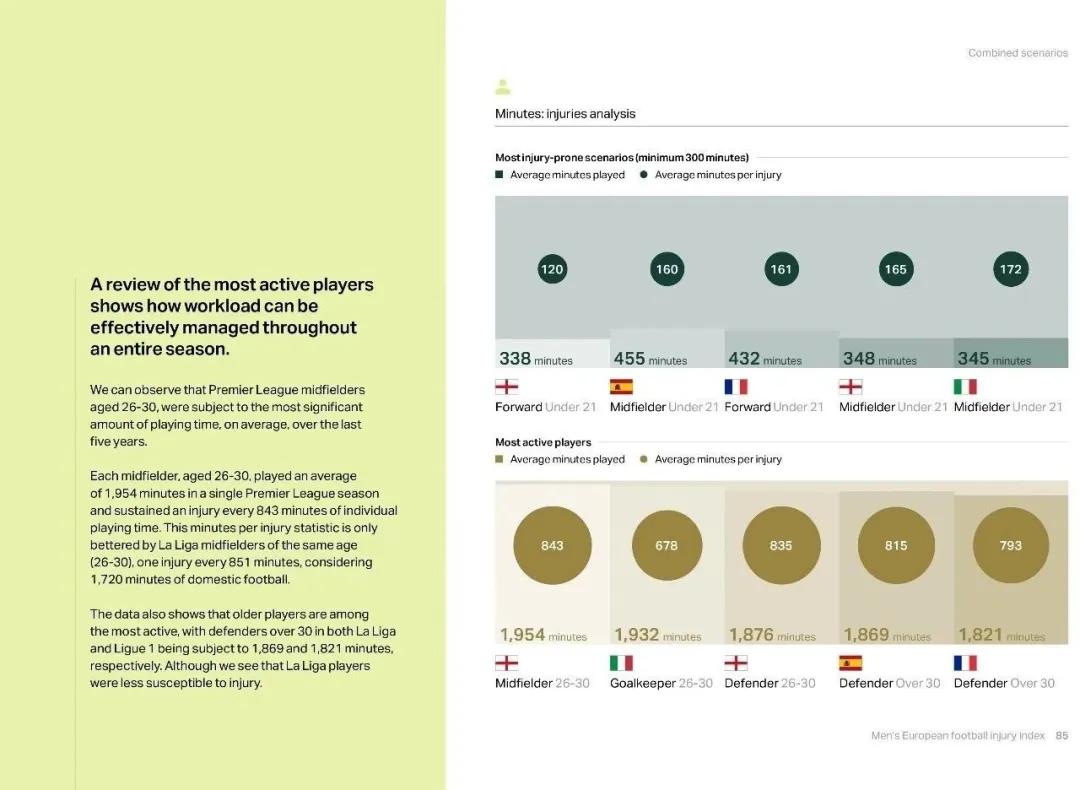
Additionally, the Howden report categorizes players into four age groups: under 21, 21-25, 26-30, and over 30, and calculates the average injury duration for players who played at least 300 minutes per season. Over the past five seasons, the average playing time for U21 players in the top five leagues rose from 414 minutes to 523 minutes, with a notable increase in injuries. The average injury duration for U21 players jumped from 16.77 days before the 2020/21 season to 30.25 days in the 2024/25 season. By contrast, the 21-25 age group’s average injury duration in 2024/25 was only 21.76 days. The peak injury absence for U21 players was in the 2023/24 season (35.37 days), far exceeding the other three age groups.
In the Premier League, on average, one U21 forward gets injured every 120 minutes played, nearly three times the injury rate of all players (338 minutes). Elite sports injury risk expert Thorpe believes that in recent years, the Premier League has generally promoted more young players to the first team, exposing them prematurely to the league’s high-intensity and fast-paced demands, making an increase in injury risk inevitable.
Although clubs in the top five leagues have made significant progress in sports rehabilitation and injury prevention based on big data and advanced technology, they still struggle to substantially reduce their “injury costs.” Ultimately, the root cause lies in the profit-driven increase in the number of matches, leaving players overwhelmed and fatigued.


Wonderfulshortvideo
Did you get it? 🤔😅


Haaland’s movement 🥵
Which counterattack is
When you use your girlfriends shower 🚿 @Emily Bourne @LUSH
Neymar highlights neymar edit neymar lamine yamal celebration
Arsenal 1-0 chelsea havertz goal
When Diogo Costa made himself a hero 🧤
 Links
Links
 Contact
Address:UNIT 1804 SOUTH BANK TOWER, 55 UPPER GROUND,LONDON ENGLAND SE1 9E
Number:+85259695367
E-mali:[email protected]
 App
App


