



Premier League Wealth Formula: "Growing the Pie, Sharing More of It"



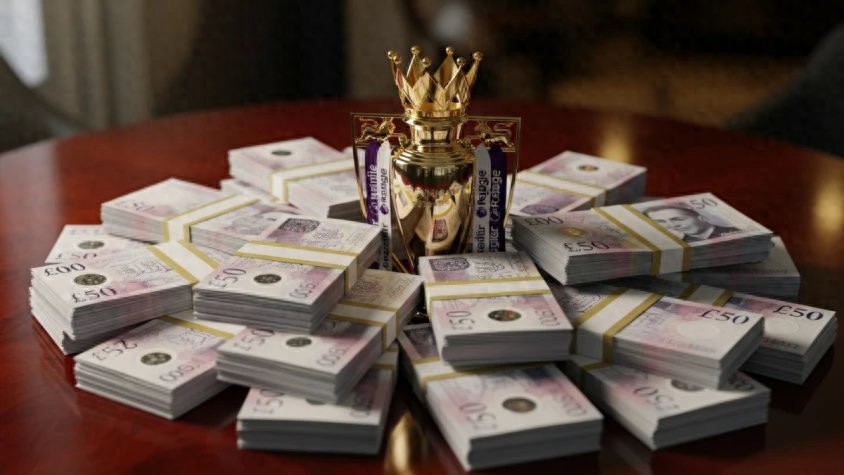
By Han Bing In the 2024/25 Deloitte Football Money League, Premier League clubs failed to reach the top 4 for the first time ever. Yet, the Premier League BIG 6 held all the other positions within the top 10, preserving their powerful group dominance. Moreover, 9 clubs from the Premier League are in the top 20 and 15 in the top 30, showing the league’s "collective advantage" as a unified competition.
Among the top 30 in Deloitte's Football Money League, Premier League clubs outnumber the combined total from the four major European leagues, matching last summer’s record where Premier League investment exceeded that of the big four combined. This also confirms the Premier League’s revenue strength as a "dimensional reduction strike" against the continental leagues. Under a relatively equitable distribution of TV broadcast income, the Premier League narrows club revenue gaps by expanding the total "pie," realizing a "collective monopoly." Compared to the traditional revenue skew towards top clubs in continental leagues, the Premier League’s "collective monopoly" model promises even greater future advantages. The current competitive structure of the big four European leagues, dominated by four giants and 8-10 near-elite clubs competing with the Premier League collectively, is likely to persist for some time.
Distribution Model Determines Collective Monopoly Pattern
In the 2024/25 Deloitte Football Money League, the leading continental giants owe much of their high rankings to the fortuitous "variable" of Club World Cup revenues. Real Madrid, Bayern Munich, and Paris Saint-Germain all participated in the Club World Cup, earning substantial prize money and broadcast income. Although Barcelona did not participate, they secured the Spanish treble and reached the Champions League semifinals, gaining higher bonuses and broadcast returns from the revamped Champions League, partially offsetting the absence of Club World Cup earnings.
Among the traditional Premier League six, only Manchester City and Chelsea took part in the Club World Cup. Last season, Manchester City only won the Community Shield, exited the Champions League in the playoff round, and were eliminated in the Club World Cup round of 16; Chelsea’s Europa Conference League income was just one-seventh of Champions League earnings, and only half of their Club World Cup revenue counted in last season’s financial year. Despite this, the Premier League’s traditional six firmly hold the top 10 spots on the wealth list. Liverpool, Manchester City, Arsenal, and Manchester United all belong to the elite group with seasonal revenues around €800 million, and even Chelsea, with the lowest revenue among them, leads Inter Milan (11th) by nearly €50 million.
Thanks to continually rising TV broadcast revenues, especially from overseas markets, the Premier League’s six top clubs have consistently ranked within the top 11 in Deloitte’s wealth rankings for the past nine seasons, strengthening their group monopoly. Unlike the continental leagues that favor top clubs in revenue distribution, the Premier League maintains a more balanced approach based on league ranking and broadcast appearances, resulting in less extreme wealth disparity. Domestic broadcast revenue is split 50% evenly among all 20 clubs, 25% based on league position (with a €4 million difference per rank), and 25% according to broadcast appearances (€950,000 per match). Overseas broadcast revenue is distributed only through equal sharing and league ranking, plus €183 million commercial income shared evenly.
In the 2024/25 season, among the Premier League’s traditional six, Liverpool leads with €200 million in league TV broadcast income, while Tottenham, ranked 16th, earns €146 million — a difference of just €54 million. This extreme case means the gap between the 1st and 16th placed teams is only 1.37 times. The relatively small broadcast income gap among the top six helps sustain their elite economic competitiveness. Even relegated teams receive over €125 million in broadcast revenue, significantly boosting the league’s overall competitive strength. This advantage secures higher-value TV contracts and greater matchday revenues driven by stronger competition.
In La Liga, the highest TV broadcast income belongs to Real Madrid (€158 million), which is €100 million more than Villarreal (€58 million), the 6th highest in seasonal revenue — a difference of over 2.7 times. Compared to Rayo Vallecano (€43 million) in 16th place, the gap widens to €115 million, a 4-fold difference! Income resources heavily favor Real Madrid and Barcelona, preventing the formation of a multi-power competitive landscape. The very low and uneven broadcast revenues for smaller clubs make it difficult for the "oligarchic" monopoly to expand the overall league revenue "pie."
Overseas Market "First-Mover" Advantage Stands Out
The new domestic broadcast contract for the Premier League from 2025 to 2029 grows by only 4% compared to the previous deal. Meanwhile, La Liga, Serie A, and Bundesliga contracts have stagnated, and Ligue 1’s even collapsed, forcing the league to create its own broadcast platform. However, the Premier League’s long-established "first-mover" advantage in global markets, combined with its distribution model that prioritizes league competitiveness more than continental leagues, enables its overseas broadcast contracts to continue rapid growth. Between 2025 and 2028, the Premier League’s overseas TV broadcast contract value increases by 23% (to €2.5 billion annually), even surpassing domestic broadcast income (€2 billion annually).
This means starting this season, the 20 Premier League clubs will share over €4.5 billion in broadcast income annually, an increase of at least €1.25 billion from last season. This alone can raise the average revenue of the traditional Premier League big six by at least €60 million compared to last season. Given the absence of Club World Cup prize money this season, Premier League clubs’ return to the Deloitte Football Money League top four is virtually guaranteed, and the overall rankings of the big six are likely to improve. The advantage of the new broadcast contract will strengthen the Premier League six’s dominance in future Deloitte wealth rankings.
The Premier League’s strategy to grow the overall league revenue "pie" extends beyond broadcast contracts to preseason overseas market development. Especially with half of Premier League clubs now owned by North American investors, the league naturally enjoys priority access to North American market benefits. In summer 2024, the Premier League’s North American tour featured the five giants — Manchester City, Manchester United, Liverpool, Arsenal, Chelsea — alongside mid-level clubs like Aston Villa, Bournemouth, Wolves, West Ham, and Crystal Palace, all sharing in the commercial gains. Even League One’s Wrexham earned substantial commercial income playing matches against Bournemouth and Chelsea.
In contrast, overseas market development for the big four continental leagues is more a solo show by their giants. The Italian and Spanish football federations staged the Super Cup in Saudi Arabia, but appearance fees varied greatly depending on the participating teams’ influence, offering little benefit to the overseas commercial value of the two leagues’ brands. Essentially, continental leagues remain tied to a resource concentration model favoring traditional giants. This results in those clubs dominating domestic broadcast revenues and monopolizing Champions League qualification, securing Champions League prize money and broadcast bonuses, further widening club income gaps and weakening overall league competitiveness and international influence.
In the long run, the Premier League’s strategic advantage of expanding the league’s "pie" will elevate the clubs’ revenues to new heights, reinforcing the "group monopoly" advantage on the Deloitte Football Money League that will be almost impossible to overturn.


Wonderfulshortvideo
The footwork, the finish 🤌


Did you get it? 🤔😅
The Wirtz x Sané link-up 🔗
Haaland’s movement 🥵
Which counterattack is
When you use your girlfriends shower 🚿 @Emily Bourne @LUSH
🤤🤤
 Links
Links
 Contact
Address:UNIT 1804 SOUTH BANK TOWER, 55 UPPER GROUND,LONDON ENGLAND SE1 9E
Number:+85259695367
E-mali:[email protected]
 App
App


