



On the occasion of Vietnamese Physicians' Day (February 27): Vietnamese Sports and the Story of Sports Medicine



On the occasion of Vietnamese Physicians' Day (February 27), the nation's sports sector has reason to discuss more extensively a field that was once quiet but has now become a pillar: sports medicine. This is not only about ensuring the health and safety of athletes, but also a decisive factor in the competitive capacity of Vietnamese Sports during a period of deep integration with the region and the world.
In just over a year, significant changes have occurred in policies and awareness regarding medical work in sports. Since Decree 349/2025/ND-CP was issued, medical staff, doctors, and technicians have officially become an indispensable part of the national sports teams, receiving allowances, salaries, and benefits equivalent to those of coaches and athletes.
More importantly, they are now "official members" of sports teams during international competitions. This change addresses a long-standing issue that persisted for many years, where athlete healthcare depended on the financial capabilities of Federations and Associations, often causing sports doctors to be viewed as "voluntary followers".
Now, they have become an official component within the team structure, contributing to improving training quality, injury prevention, and professional recovery for athletes.
Another crucial turning point is the establishment of the Vietnam Association of Sports Medicine (VAMS), the first specialized organization to gather doctors, experts, researchers, and sports medicine technicians nationwide.
The association's mission is not only to gather human resources but also to build a professional network, promote international cooperation, and standardize practices for sports doctors. Previously, Ho Chi Minh City had a Sports Medicine Association since 1998, but its activities were fragmented, focusing more on treating common pathologies rather than research, intervention, and recovery in high-performance sports. The emergence of VAMS, therefore, not only fills this gap but also marks a new perspective: sports medicine is a profession with a strategic role in national fitness training and development.
In reality, sports medicine work in Vietnam was once considered "lagging behind achievements". Athletes only received care after injuries, while monitoring, recovery, and nutrition lacked systematic support.
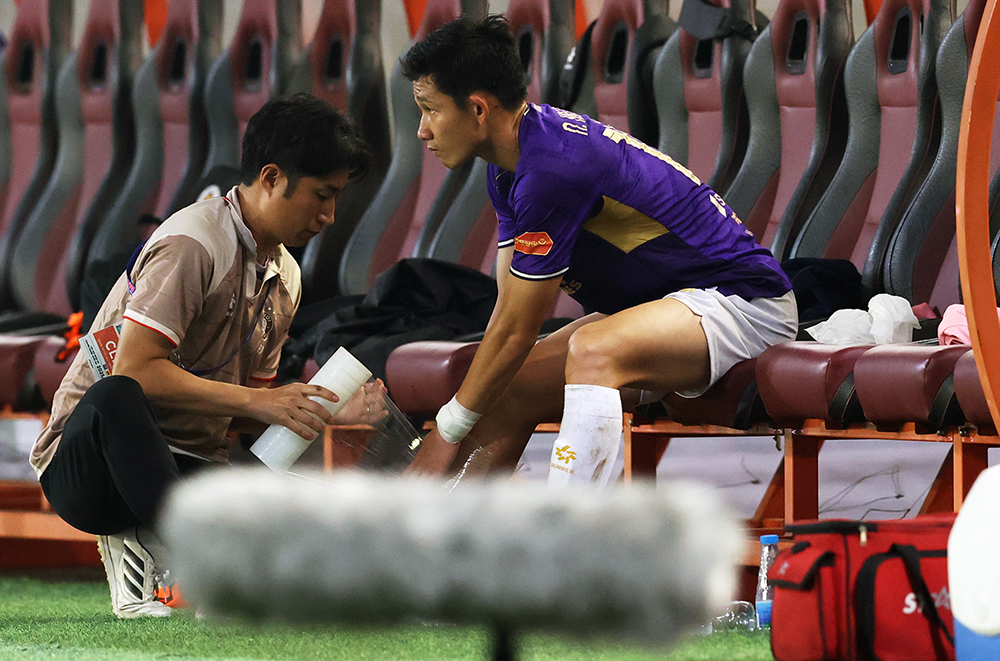
The role of healthcare in professional sports in general and professional football in particular is increasingly important. Photo: Hoang Linh
The consequence was that many talented athletes were forced to retire early or seek treatment abroad. The policy shifts over the past two years have changed this view: sports medicine is not just about "treating injuries", but is a team that safeguards performance, ensuring athletes train, compete, and recover within a closed-loop process meeting international standards.
However, the current situation still faces many challenges. Currently, the number of sports doctors at key training centers remains very limited, while the demand from national teams is growing rapidly. Ahead of the 33rd SEA Games, the National Sports Training Center in Nhon, which hosts over 80% of the athlete force, still lacks dedicated doctors, leading to inconsistent long-term health monitoring, injury control, and post-competition recovery.
Establishing a human resource training network, expanding research facilities, and encouraging medical students to specialize in sports have become urgent issues.
In the overall picture, these developments reflect a fundamental change in the perception of the Vietnamese Sports system. If sports medicine was previously just a support element, it has now become an integral part of the structure, linked to the 2030-2045 Development Strategy.
This step shows that the State invests not only in facilities or coach training, but also cares about the foundation of sports medicine and science, considering it a key to helping Vietnamese athletes enhance endurance and minimize risks on their journey to new heights. Along with the Sports Economy, the attention to the sports medical team demonstrates the determination of Vietnamese Sports to reach higher levels.
On Vietnamese Physicians' Day, we not only honor medical professionals but also express gratitude to the "silent heroes" behind the medals.
Sports is not just about physical strength, but also the culmination of science and medicine. Vietnamese Sports will undoubtedly be more confident on its journey to conquer new peaks.


Wonderfulshortvideo
User VictoryVox has posted a video.


 Links
Links
 Contact
Address:UNIT 1804 SOUTH BANK TOWER, 55 UPPER GROUND,LONDON ENGLAND SE1 9E
Number:+85259695367
E-mali:[email protected]
 App
App


