



Does women's football need a foreign coach?



Alongside domestic candidates for the position left by Coach Mai Duc Chung, another direction worth considering is a foreign coach, something even top Asian women's football nations like Japan have chosen.
1. After a glorious period with the 2011 World Cup victory and runner-up finish in 2015, the Japanese women's national team began to stagnate, despite still possessing abundant talent. The JFA therefore wanted a real change in how the team operates.
At the end of 2024, they placed their trust in Nils Nielsen, the first foreign coach in the history of Nadeshiko. The Greenland-born coach had previously helped Denmark reach the final of the 2017 Women's EURO, led the Swiss women's team from 2018 to 2022, and also served as the football director for Manchester City Women.
Japanese women's football is renowned for its technical play and ball control. However, they are sometimes criticized for lacking tactical diversity and a "killer instinct" in decisive moments. According to Nielsen, if football only took place in midfield, Japan might be the strongest in the world due to their technique and coordination. But football is decided in the two penalty areas, where intensity and courage in duels are required.
Therefore, Nielsen's task is not to change the identity of Japanese football, but to supplement the missing elements. He wants to help the players be more assertive in one-on-one situations, more decisive in finishing, and more confident when competing against top opponents.
Another reason the JFA trusted Nielsen is his ability to connect with players competing in Europe. Most Japanese national team players currently play for clubs in this continent, and his experience working at Manchester City helps Nielsen easily monitor and manage the squad. More importantly, the JFA wanted a fresh influx of thinking. When old methods no longer yield results, a new perspective from outside could be the key to helping the team regain its position on the world women's football map.
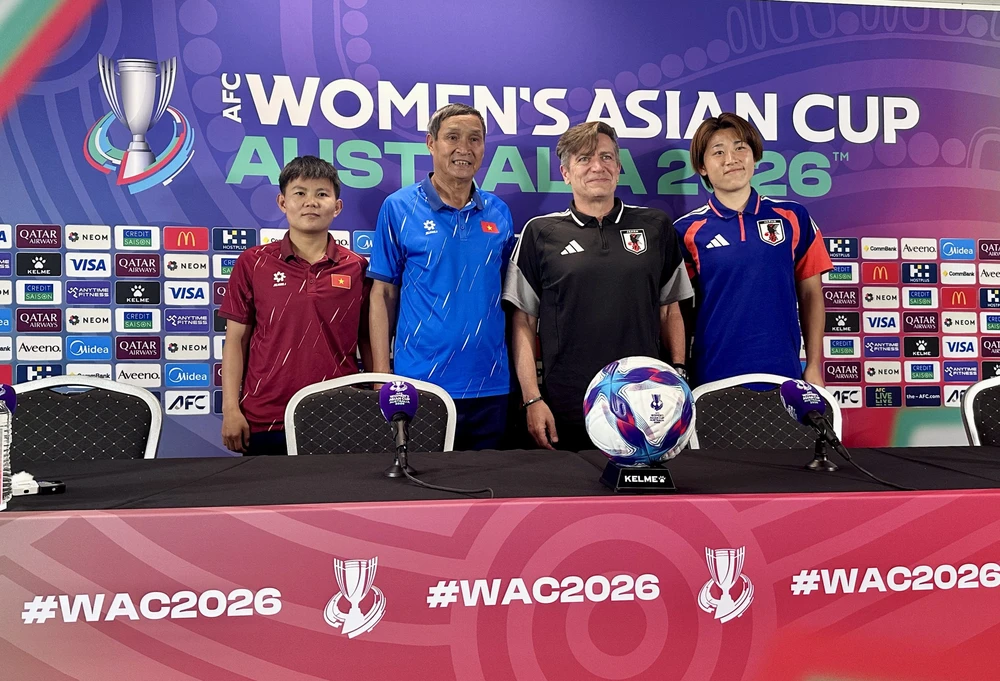
Nils Nielsen is the first foreign coach in the history of the Japanese women's national football team. Photo AFC
2. Japan's story also presents a thought-provoking suggestion for Vietnamese women's football, as the VFF needs to find a successor to Coach Mai Duc Chung while the national team is entering a phase of reconstruction and generational transition.
Domestically, several candidates have been mentioned, notably Hoang Van Phuc, who won the V-League 2017 with Quang Nam Club and has many years of coaching experience. His involvement in the women's national team coaching staff recently has been seen as preparation for a potential succession.
But a foreign coach could bring modern training methods, new tactical thinking, and experience from developed football environments. The VFF once considered appointing Akira Ijiri, who has worked for many years with Vietnamese youth women's teams. However, that plan was ultimately not implemented. Now, the succession problem is once again on the table. The important thing is that the successor must have sufficient stature not only to maintain past achievements but also to elevate the team to a new level.
In the context of the rapidly developing world women's football, accessing modern coaching trends is essential. A suitably chosen foreign coach could act as a "strategic brain" for the reconstruction phase, while also helping to elevate football thinking across the entire system.
Of course, a foreign coach is not a "magic wand" that can solve all problems. Success or failure depends on many factors such as suitability to the environment, ability to cooperate with domestic assistants, and the long-term vision of the federation. But looking at how an Asian powerhouse like Japan is willing to change to rejuvenate its team, perhaps Vietnamese women's football should also broaden its perspective.
After the Mai Duc Chung era, the question is not only who replaces him, but also which direction Vietnamese women's football wants to develop in the future. And on that journey, a "foreign brain" could be a choice worth considering.


Wonderfulshortvideo
Kvaratskhelia and Ronaldo 🫶


🇪🇸 Spain 🆚 Argentina 🇦🇷
Arsenal goal today arsenal 2-1 chelsea arteta interview arteta press conference
When Diogo Costa saved EVERY penalty he faced in the shoot-out 🤯🤯🤯
The movement is electric ⚡️
Mbappe injury mbappe surgery real madrid 0-1 getafe mbappe return date mbappe edit
ronaldo almeria ronaldo buying new club ronaldo owner ronaldo manchester united owner
 Links
Links
 Contact
Address:UNIT 1804 SOUTH BANK TOWER, 55 UPPER GROUND,LONDON ENGLAND SE1 9E
Number:+85259695367
E-mali:[email protected]
 App
App


