



The void after Coach Mai Duc Chung


Coach Mai Duc Chung will not return to lead the Vietnamese women's national football team again due to age and the need for change. However, selecting someone to replace him as the head coach of the national team remains an issue, even though the Vietnam Football Federation (VFF) already has a primary candidate.
Behind-the-scenes sources indicate that it is Coach Hoang Van Phuc, former head coach of the Vietnam U22 team, who has experience working in V-League with Hanoi Club, Quang Nam, and has spent a considerable time involved in youth training at the Capital team.
Bringing Coach Hoang Van Phuc into the coaching staff of the Vietnamese women's team for SEA Games 33 and the 2026 Asian Cup Finals is the first step toward a real transition in the "head coach" position.
It is understood that appointing Mr. Hoang Van Phuc as head coach of the Vietnamese women's national team requires time and must be approved by the National Coaching Council, but this seems to be merely an administrative procedure. Mr. Phuc is the person VFF considers most suitable for the Vietnamese women's football team at this moment, yet there are still certain doubts. He has coaching experience, but Coach Hoang Van Phuc has never worked with any women's football team.
According to what Coach Mai Duc Chung himself shared, a coach of the women's team must have sincere affection for the players. Only with genuine concern can a coach truly care for the players well, monitor their daily lives, and even pay attention to each player's family circumstances. Then, the players can feel the coach's care. On the field, the coach must know how to inspire and oversee the match's developments. Besides expertise, the coach also has to handle many other tasks such as internal and external affairs, and team management.
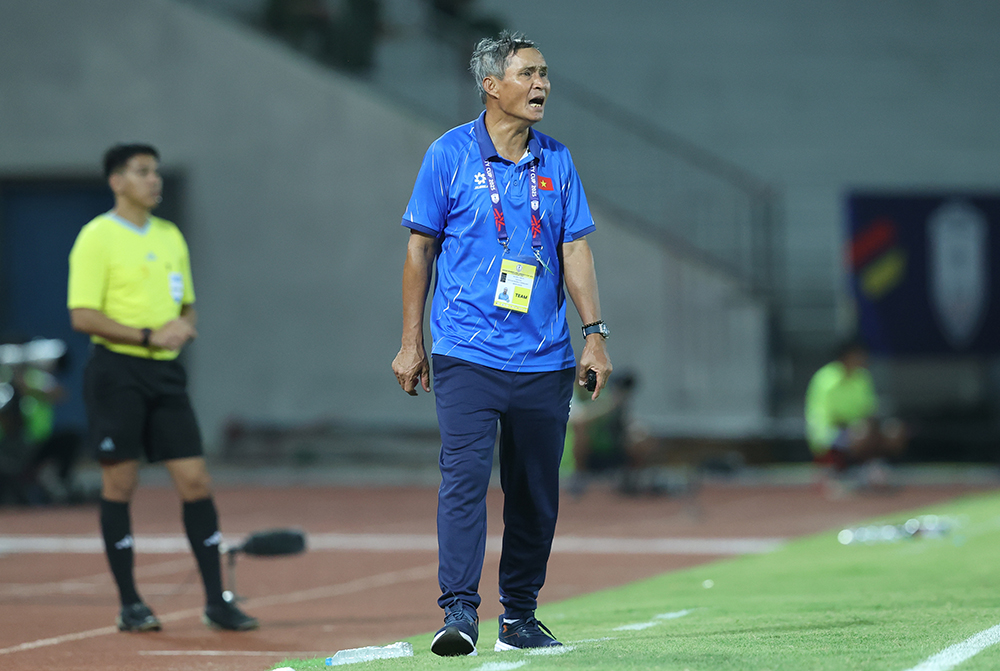
Replacing Coach Mai Duc Chung's position in the Vietnamese women's national team is a very challenging task. Photo: Hoang Linh
However, the void left by Coach Mai Duc Chung in Vietnamese women's football is not limited to that. Revitalizing the national team is necessary, and in fact, Coach Mai Duc Chung himself implemented this by integrating some young players into the lineup from SEA Games 33 to the recent Asian Cup.
However, the contributions of Thuy Hang, Truc Huong, Hai Linh, Ngoc Minh Chuyen, Tuyet Ngan... in the Vietnamese women's national team's playing style remain relatively faint. When Huynh Nhu and Hai Yen no longer have the stamina to play full 90 minutes and shoulder the responsibility of scoring, Coach Mai Duc Chung still had to rely on Ngan Thi Van Su, a winger who is not exactly a fresh face.
The foundation of Vietnamese women's football is too thin; the national league and cup competitions annually still only involve Hanoi, Ho Chi Minh City, Phong Phu Ha Nam, Than KSVN, Thai Nguyen, and Son La. Not only limited in quantity, the quality of youth training in women's football is also relatively constrained.
This reality highlights the issue that reforming Vietnamese women's football and revitalizing the national team is necessary but not easy, and the role of Coach Mai Duc Chung's successor is extremely crucial. It is not just about immediate performance requirements but also about establishing a systematic plan and roadmap for the long-term development of our country's women's football.


Wonderfulshortvideo
Kvaratskhelia and Ronaldo 🫶


🇪🇸 Spain 🆚 Argentina 🇦🇷
Arsenal goal today arsenal 2-1 chelsea arteta interview arteta press conference
When Diogo Costa saved EVERY penalty he faced in the shoot-out 🤯🤯🤯
The movement is electric ⚡️
Mbappe injury mbappe surgery real madrid 0-1 getafe mbappe return date mbappe edit
ronaldo almeria ronaldo buying new club ronaldo owner ronaldo manchester united owner
 Links
Links
 Contact
Address:UNIT 1804 SOUTH BANK TOWER, 55 UPPER GROUND,LONDON ENGLAND SE1 9E
Number:+85259695367
E-mali:[email protected]
 App
App


