



Will the Premier League retain its fifth Champions League spot next season?



A forgettable week in the Champions League has shocked English football. With four out of six Premier League representatives eliminated in the round of 16, the immediate question arises: will the planet's most exciting league keep its fifth Champions League spot next season?
According to UEFA regulations, the two nations with the best performance across the three European cups—Champions League, Europa League, and Conference League—will be awarded "European Performance Spots" (EPS). This means their domestic league will gain an additional Champions League spot, a ticket originally intended for the fifth-placed team.
England remains in the "upper bracket"
Last season, this mechanism allowed Newcastle to qualify for the Champions League despite not finishing in the top four. And this season, despite facing many difficulties, English football is very close to repeating that achievement.
Despite suffering heavy losses in the round of 16, England still leads the UEFA coefficient table with a score of 23.847, nearly matching La Liga's performance from last season when it ranked second.
The gap between the Premier League and its chasing rivals is substantial. Spanish and German clubs are currently trailing by nearly 18 wins, a number sufficient to demonstrate England's clear advantage. Even Serie A has almost lost its chance to compete.
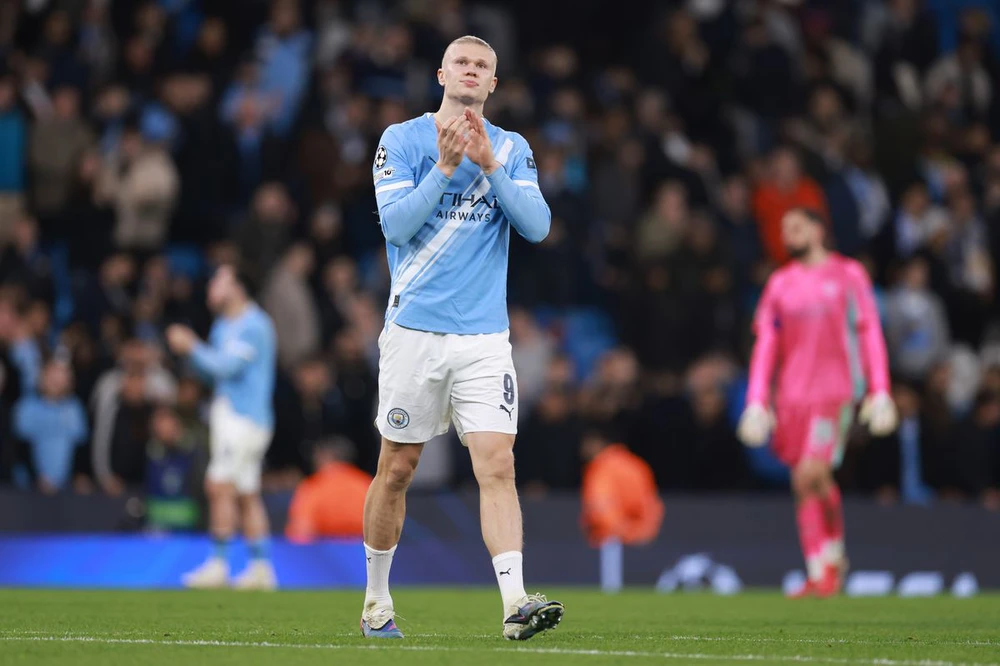
Despite suffering heavy losses in the round of 16, England still leads the UEFA coefficient table
However, everything is not yet completely certain. The 2023-24 season witnessed a similar scenario, where England seemed assured of the EPS but collapsed in the quarter-finals. Therefore, risk still exists, though it is not significant.
How are the competitors performing?
La Liga currently ranks second and is the Premier League's biggest competitor. Spain's strength lies in having six representatives still in European competitions. However, their disadvantage is that clubs will eliminate each other directly, such as the clash between Barcelona and Atletico Madrid in the Champions League quarter-finals.
Similarly, in the Europa League, the possibility of Celta Vigo and Real Betis facing each other would also cause La Liga to "cancel out" coefficient points.
For the Bundesliga, the opportunity is very slim. They only have Bayern Munich left in the Champions League, and this team must face Real Madrid, a match where one of England's direct competitors will certainly be eliminated.

Direct knockout matches between competitors help English football maintain its leading position
Meanwhile, German representatives in the Europa League and Conference League lack advantages, making a breakthrough nearly impossible.
Primeira Liga and Ligue 1 still have a few representatives, but the point gap is too large to bridge.
The coefficient calculation mechanism and England's advantage
The UEFA coefficient is calculated based on the total points earned by clubs, then averaged by the number of participating teams. Each win brings 2 points, a draw earns 1 point, plus bonus points according to performance in each competition.
A notable point is that the Champions League yields significantly more bonus points compared to the Europa League or Conference League. This gives leagues with many Champions League representatives, like the Premier League, a clear advantage.
Therefore, despite early elimination, English clubs have accumulated enough points to maintain the leading position.
Despite experiencing a disappointing week in the Champions League, the Premier League still holds the decisive power in the race for the fifth spot. A large coefficient advantage and direct knockout matches between competitors help English football maintain its leading position.
Unless an unbelievable collapse occurs in the upcoming rounds, it is almost certain that the Premier League will continue to have five representatives in the Champions League next season. And then, the domestic race for the top five will become fiercer than ever.


Wonderfulshortvideo
Kvaratskhelia and Ronaldo 🫶


🇪🇸 Spain 🆚 Argentina 🇦🇷
Arsenal goal today arsenal 2-1 chelsea arteta interview arteta press conference
When Diogo Costa saved EVERY penalty he faced in the shoot-out 🤯🤯🤯
The movement is electric ⚡️
Mbappe injury mbappe surgery real madrid 0-1 getafe mbappe return date mbappe edit
ronaldo almeria ronaldo buying new club ronaldo owner ronaldo manchester united owner
 Links
Links
 Contact
Address:UNIT 1804 SOUTH BANK TOWER, 55 UPPER GROUND,LONDON ENGLAND SE1 9E
Number:+85259695367
E-mali:[email protected]
 App
App


