



What should be done to salvage Liverpool's season, Arne Slot?



After a winning streak in the first five rounds, Liverpool has been in free fall, now facing the risk of ending the season without achieving any major goals.
In this context, the biggest question is no longer about championship ambitions, but rather what Arne Slot must do to salvage a season that has strayed far off course.
The tactical and fitness challenge
One of the core reasons for Liverpool's decline is the drop in fitness and intensity. Under Jurgen Klopp, high pressing and relentless tempo were the identity that enabled The Kop to dominate opponents. However, the current version of Liverpool under Arne Slot is no longer able to maintain that foundation consistently.
Statistics clearly reflect the issue. Liverpool often falls behind opponents in distance covered, particularly in the second half. The loss to Brighton is a typical example: After a balanced first half, Liverpool noticeably faded and nearly lost control of the match. Notably, this pattern has repeated multiple times throughout the season.
Slot must face the reality that the current squad lacks the fitness to sustain a high-intensity pressing style multiple times per week. Trying to fully replicate Klopp's approach under current personnel and a congested schedule would only wear Liverpool down. Instead, a more flexible and pragmatic approach is necessary.
Liverpool may need to accept a deeper defensive line, lower tempo, and prioritize solidity in difficult matches. Choosing the right moments to accelerate, rather than constant pressure, would help them conserve energy and maintain composure in the final stages. In fact, this approach yielded some positive results early in 2026, even if it was less exciting stylistically.
Additionally, sensible rotation, utilizing more youth or substitute players, would help relieve the overloaded core group. If the fitness issue is not resolved, any other tactical adjustments will become meaningless.
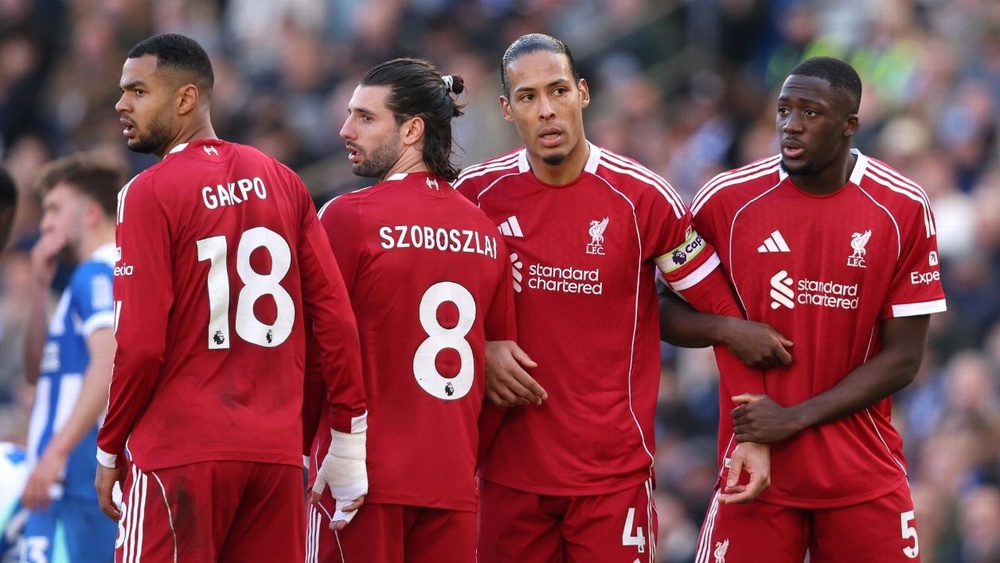
Liverpool needs to define realistic goals for the remainder of the season
Setting realistic objectives
Beyond fitness, another major problem for Liverpool lies in their competitive mentality. The team can excel against top opponents in the Champions League, but lacks resilience in the long-haul matches of the Premier League.
Many players in the current squad possess impressive technique and football intelligence, but lack the necessary grit. Under pressure, Liverpool often loses initiative. This explains why they repeatedly drop points against lower-rated but fiercely competitive teams.
Liverpool's attacking efficiency is also problematic. Liverpool currently dominates possession but lacks sharpness in finishing and chance creation. Simplifying their play, increasing ball circulation speed, and better exploiting transitional moments would improve their effectiveness in the final third.
Given the current situation, competing for the championship or advancing deep in the Champions League is an overly ambitious task. Instead, the most practical goal is securing a Top 5 position to ensure Champions League qualification next season.
Cup competitions could become opportunities for Liverpool to pursue a trophy, but should not be the top priority. With a packed schedule and depleted squad, spreading their efforts could cost them even the most achievable targets.
Finally, the topic of changing the manager is raised, but this is not the optimal solution at present. Liverpool's problems are systemic, involving fitness, squad depth, and mentality. A change in the coaching staff is unlikely to provide a complete fix in a short time.
The chance to salvage the season still exists, but it is limited. Arne Slot needs to implement more practical and decisive adjustments promptly. More importantly, he must help Liverpool rediscover its identity and confidence.
If that can be achieved, Liverpool could end the season with at least a positive foundation for the future.



 Links
Links
 Contact
Address:UNIT 1804 SOUTH BANK TOWER, 55 UPPER GROUND,LONDON ENGLAND SE1 9E
Number:+85259695367
E-mali:[email protected]
 App
App


