



11 mathematical models predict 4 World Cup championship contenders




According to the UK's Daily Mail, Dr. Ari Joury, a nuclear physicist and founder of the AI company Wangari, developed 11 independent forecasting models to assess the championship chances of teams participating in this year's World Cup.
The results show that only four teams are selected by the models as top contenders for the prestigious golden trophy. Spain enjoys overwhelming support, with 7 out of 11 models predicting its victory. Argentina was chosen by two models, while France and the Netherlands each received one prediction.
When aggregating results from all models, Spain leads with a championship probability of about 20%. France and Argentina follow, both at 14%, while the Netherlands stands at 10%.
Notably, no model rated England as the top candidate. According to the average calculation, the "Three Lions" have only a 9% chance of winning. However, Dr. Joury noted that this figure does not mean England has no chance to compete.
"A low probability is not a prediction of failure. It simply reflects the highly competitive nature of the tournament. When many strong contenders vie for the title, chances become more evenly distributed," he commented.
Spain stands out as the leading contender
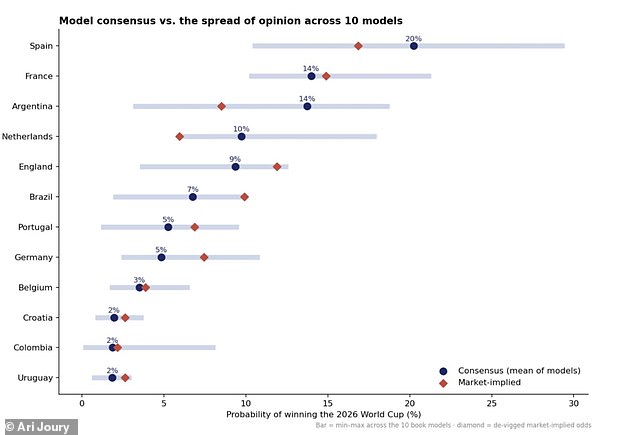
The study indicates that Spain is the only team receiving relatively clear consensus from the forecasting models.
As many as five systems assess La Roja's championship probability above the 25% threshold, with one model even giving them nearly a 33% chance of lifting the trophy.
Meanwhile, even the models that chose France or Argentina as top candidates did not place absolute confidence in them. For instance, the model that rated France's championship chances highest still gave the blue-clad team only about a 12% probability of winning.
Nevertheless, Dr. Joury emphasized that being the top contender does not mean Spain can expect a smooth journey.
"Even the highest-rated team has a greater chance of not winning than of winning. Football in cup tournaments always contains many variables, and a single moment can change the entire situation," he said.
Why do the models yield different results?
One notable aspect of the study is the significant disparity among the forecasting systems.
In a hypothetical match between Spain and Morocco, Spain's probability of victory fluctuates from 25% to 69% depending on the model. Some systems even consider a draw the most likely outcome.
According to Dr. Joury, the differences stem from how each model processes data. Some systems prioritize recent form, while others focus on long-term performance. Some models predict scores, while others directly calculate win-draw-loss probabilities.
"No model is perfect. Combining multiple approaches helps reduce the error margin of individual systems and creates a more balanced picture," he explained.
Supercomputer prediction results
Dr. Joury's findings are quite similar to predictions from a research group at the University of Liverpool.
Using a supercomputer to simulate the entire tournament 1,000 times, scientists found the most likely scenario to be a final between England and Spain, with the Iberian Peninsula representative emerging victorious.
According to this simulation, England has a 29% chance of reaching the final and a 17% chance of winning. Meanwhile, Spain remains the strongest contender with a championship probability of approximately 26%.


Wonderfulshortvideo

🗣️ “As a group we can’t accept that, I can’t accept that”



Shea Lacey handing out advice to Benjamin Šeško 😅

messi new club news football today ronaldo new club owner

🗣️ Man Utd boss Michael Carrick responds after the controversial goal that settled the Manchester Derby last weekend

Now this backpass is every goalkeeper's 𝐰𝐨𝐫𝐬𝐭 𝐧𝐢𝐠𝐡𝐭𝐦𝐚𝐫𝐞 🫠

vinicius junior else vini jr today

🗣️ “I’ve won games playing much worse than today”
 Links
Links
 Contact
 App
App


