



World Cup and lessons for Vietnamese football from island nations



Observing how Curacao and Cabo Verde etched their names into history in North America, numerous Vietnamese supporters experience a blend of recognition and wistfulness. Those squads hailing from tiny island countries appear to carry numerous traits that Vietnamese football formerly had. Consequently, a query emerges: if Curacao or Cabo Verde can reach the World Cup and make their presence felt, what is the distance between Vietnamese football and that global arena?
The story of Cabo Verde and Curacao is often told as an inspirational one: spirit, unity, and ambition. That is not wrong. In fact, if we only look at fighting spirit, cohesion, and the will to overcome difficulties, the gap is not that huge. Neither Curacao nor Cabo Verde have a rich football tradition, a prestigious domestic league, or world-class stars. Yet they entered the World Cup with a clear belief that a tightly knit collective can still achieve things beyond expectations.
Those are also the values that once defined Vietnamese football during many periods. From the 2008 AFF Cup victory, the journey to the 2019 Asian Cup quarterfinals, to the first appearance in the final round of Asian World Cup qualifying for 2022, the Vietnamese team has always been described as a squad full of fighting spirit and unwilling to surrender in the face of adversity.
However, the 2026 World Cup also presents another reality: spirit alone is not enough.
The vast majority of Cabo Verde's players are of Portuguese descent, born or raised in Europe. Curacao's players are mostly from the Dutch diaspora. They are not top-tier stars: Vozinha plays in the Portuguese second division with a transfer value of 50,000 euros, an amount insufficient to buy a mid-range car in Western Europe. Cabo Verde's squad is generally assembled from lower European leagues (Bulgaria, Hungary) or second-tier divisions of Portugal, the Netherlands, Belgium, etc.
International experience is not a prominent strength either. Both teams have not played many matches at the highest level—this is natural for football nations outside the FIFA top 50. Therefore, the accumulation of individual player experience is what truly matters.
What makes the difference lies in the ability to maintain playing intensity.
Curacao could withstand pressure throughout the entire match against Ecuador. Cabo Verde could maintain focus and organization when facing opponents of superior class. They do not have much possession, they do not create many chances, but they still have enough capability to survive in the harsh environment of the World Cup. This comes not only from willpower but also reflects the quality of training, physical foundation, and adaptability to the pace of modern football.
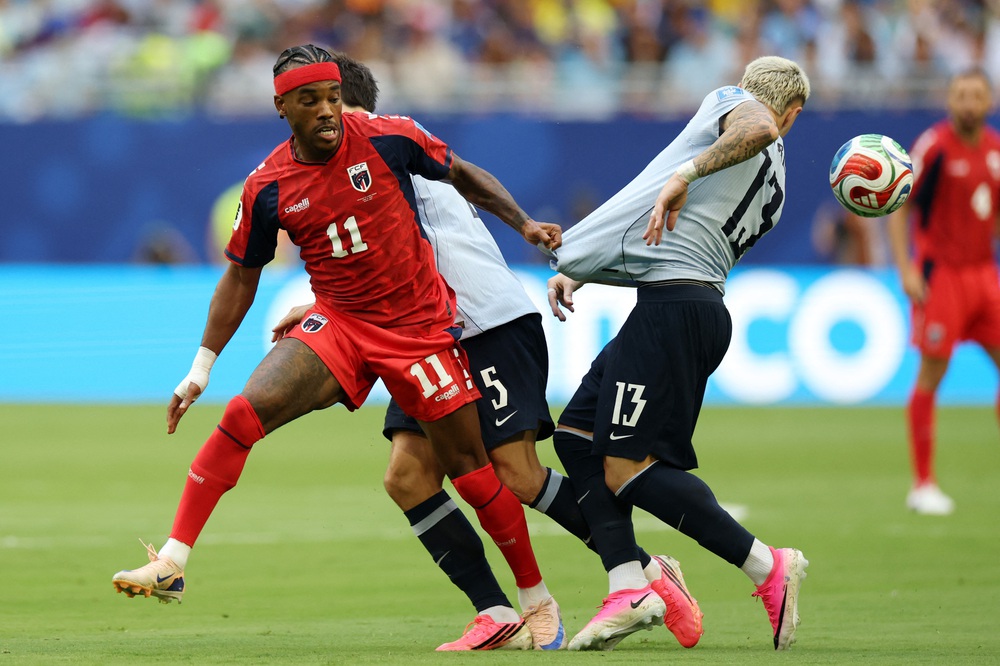
Cabo Verde (dark shirts) is one of the most intriguing discoveries of the 2026 World Cup. Photo: AFP/TTXVN
Japan is the most typical example in Asia. The team of coach Hajime Moriyasu is not always technically superior to European opponents, but they can sustain the same intensity for 90 minutes. That is what allowed Japan to find an equalizer against the Netherlands in the closing minutes, or to keep scoring against Tunisia even when the match entered a phase where many teams would allow themselves to loosen up and conserve energy. Other Asian teams like Saudi Arabia or Iran, despite having more World Cup experience and better physical attributes, still lag in playing intensity. They all decline towards the end of matches, and most of their goals conceded come in that period.
That is also the biggest gap between Vietnamese football and the World Cup.
Debates about naturalizing players or sending players abroad are certainly necessary, but both are long-term solutions. Meanwhile, raising playing intensity is an issue that needs to be addressed domestically right away.
There is a statistic that is not new but still worth recalling in the context of the 2026 World Cup: a Japanese expert once noted that the actual ball-in-play time in V-League matches averages only 44 minutes, compared to 65 minutes in Europe and 55 minutes in Japan.
Recent updated figures are not more encouraging: the average ball-in-play time in the V-League over the past decade remains around 50 minutes per match, with some matches falling below 40 minutes.
This has nothing to do with spirit. It is an issue of playing discipline and tactical mindset. When players are unable or unwilling to play at high intensity for 90 minutes, several "distortions" appear: lying on the ground to waste time, slow ball restarts, excessive arguing with referees, or, from a technical perspective, kicking long balls to foreign strikers in attack or desperately clearing the ball as far as possible in defense. All of these lead to minimal ball control time.
Vietnamese football does not lack spirit. But willpower and physical fitness are two different things. Willpower helps you not give up. Physical fitness helps you not run out of energy.
And playing intensity—the kind that Cabo Verde displayed for 90 minutes against Spain or Uruguay—is not something that can be "turned on" when needed, unless it has been built over years of training, thousands of hours of practice, and matches played at true intensity.





 網站地圖
網站地圖
 聯絡方式
聯絡方式
 App
App


