



World Cup on Home Soil: From Cape Verde to... Singapore



Even before Cape Verde's historic advancement to the knockout stage, just after their 0-0 draw with Spain in the opening match of the 2026 World Cup, a seemingly logical question arose everywhere: if a small island nation with half a million people could achieve such a remarkable feat, why can't we? Singaporean football is also subject to that comparison, since in comparison with other Southeast Asian nations, Singapore is affluent, led the way in player naturalization, and was once the leading football force in the area.
However, when CNA (Asia's media channel based in Singapore) reporters posed this question to Singaporean football experts, the response was nearly unanimous: this is a comparison of "two different worlds," and it is unfair to both sides. Behind that consensus lies an important lesson: do not hastily copy the success model of others.
The first argument to be dismissed was the link between population size and football performance. Football expert Khairul Asyraf pointed out that population scale has never been a direct measure of top-tier football quality. Reality also confirms this: among the five most populous countries in the world, India and Pakistan have never qualified for the World Cup, China has only participated once in 2002, and Indonesia only appeared in 1938 under the name Dutch East Indies. If a large population were a sufficient condition for success, the world football map would be completely different.
More than half of Cape Verde's 2026 World Cup squad came from the Cape Verdean diaspora in the Netherlands, Portugal, and France — an overseas community estimated to be larger than the domestic population. Expert James Walton from Deloitte pointed out the core difference: for Cape Verde, the issue is not "whether there are potential players out there," but "how to convince them to choose this team instead of other options."
For Singapore (and many other countries), the question from the very beginning is different: does there exist a sufficiently large community of players of Singaporean origin abroad to persuade? Cape Verde also allows dual citizenship, while Singapore, although it has used naturalized players, has never had a player born abroad with Singaporean heritage represent the national team. The case of defender Perry Ng, who is awaiting naturalization through the foreign sports talent scheme, could be the first time.
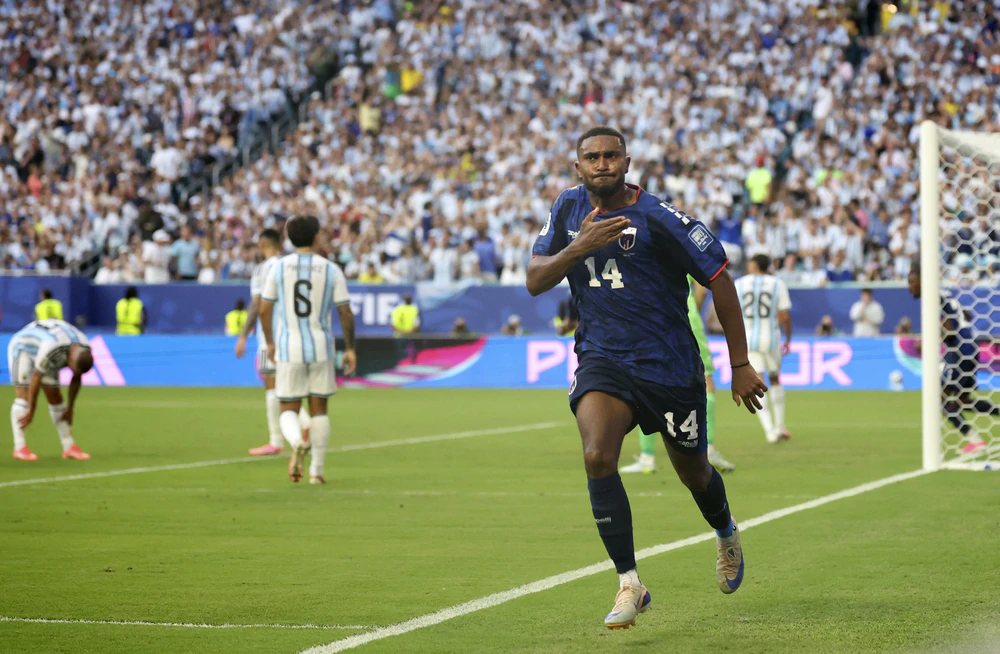
Cape Verde's success at the 2026 World Cup is extremely impressive, but replicating what Cape Verde did is far from simple. Photo: Xinhua/TTXVN
Next is social motivation. Cape Verdean journalist Victor Hugo Fortes described his country as a difficult place to live, where football is often one of the rare escape routes from poverty for a family. Conversely, former professional player Emmeric Ong remarked that Singaporean children grow up in a safe, sheltered environment and do not face a "survival" situation severe enough to forge such extreme determination. When one does not see a sufficiently attractive "ceiling" to pursue, it is also hard to have enough motivation to fight for it, according to expert Khairul.
Next, and perhaps most importantly, something many easily overlook when writing about football fairy tales: the starting point is not as equal as it appears. Cape Verde is not a newcomer in Africa: they have participated in the Africa Cup of Nations (AFCON) four times since 2013, reaching the knockout stage in 2021 and the quarter-finals in 2023. Remember, as many as 9 out of 10 African teams that advanced past the World Cup group stage, which demonstrates the high quality of AFCON. In this aspect, the Asian Cup, with its four-year cycle, is truly difficult to compare.
Finally, few people know that even for Cape Verde, despite having minimal population resources, there are more than 40 football academies established on these West African islands since around 2010, training children aged 4-17. That is the initial cradle for many Cape Verde World Cup players before they moved to Europe at ages 13-15 to receive better football education. This means Cape Verde players largely grew up in French and Portuguese academies before "returning" to play for the national team. This detail alone is a difficult technical barrier to overcome.
In summary, from the realistic perspective of Singaporean experts, the "Cape Verde fairy tale" looks beautiful but is not easy to copy. They also agree on one more point: for Singapore, the domestic league and youth training system must be strong; other options are not "ready-made conditions."
For Vietnamese football, from Singapore's "inability," will there be a choice of its own?


Wonderfulshortvideo

vinicius junior else vini jr today



🗣️ “I’ve won games playing much worse than today”

ballon d'or lamine yamal mbappe interview press conference ballon d'or winner france football edit

Leeds United demolish Newcastle at elland road

Throwback to this League Cup game between Liverpool and Spurs ⚽️⚽️
Lamine genius 🪄

raphinha assist today lamine yamal goal today brace today vs levante
 Links
Links
 Contact
 App
App


