



World Cup and the story of a system



Norway reaches the World Cup quarterfinals for the first time in history. Switzerland makes its first appearance in the top eight since 1954. Whether they advance to the semifinals or not, this is already the best showing on the World Cup stage. These two teams share one thing in common: they have gone far thanks to what we often call systematic football development.
"Super striker" Haaland is the one who scored the goal that sent Norway to the quarterfinals—that much is obvious. But why a football nation like Norway can produce such a star is what the English are trying to figure out, as part of their preparation for the quarterfinal match against this opponent.
For English experts, Norway is not a one-man team. Before this tournament, they had only advanced past the group stage once in their last three World Cup appearances, and had been absent from this event for 28 years. How such a footballing nation manages to create a generation of talent, including a superstar, is what truly matters.
Switzerland takes a different path but shares the same philosophy: since 2012, they have consistently been ranked among the top 12 teams in the FIFA rankings—a rare level of stability for a football nation without a championship tradition. Behind this lies the Swiss Football Association's multi-tiered talent selection system, combining coaches' assessments with data on physical condition, psychology, and even the family background of young players—a scientific model considered one of the most effective in Europe by sports researchers.
Most smaller football nations fall into a familiar trap: specializing too early, pouring resources into a few "prodigies" in hopes of quick medals. Norway chose the opposite. Since 1987, reinforced in 2007, the Norwegian Olympic Committee's document "Children's Rights in Sports" stipulates: children under 9 may only compete with local clubs. No rankings, no titles. By age 11, children can join regional tournaments, but scores and rankings are still banned. This applies until age 13. Another important right: children can choose any sport they like.
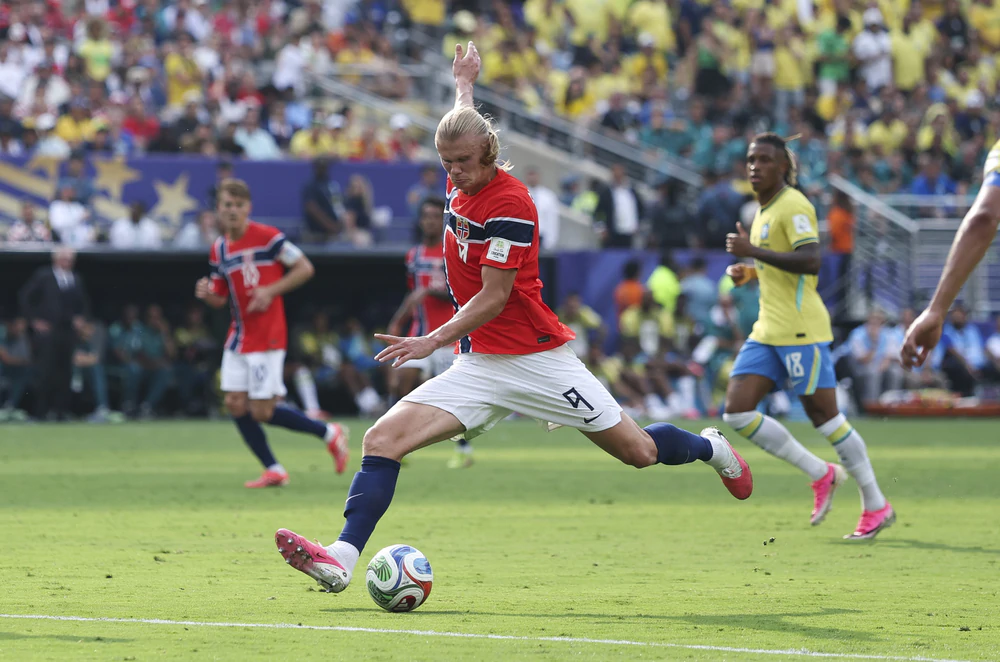
Before choosing football as his lifelong pursuit, Haaland tried his hand at handball, athletics, and cross-country skiing. Photo: Xinhua/VNA
Erling Haaland is the perfect product of this philosophy. When the rules were revised, Haaland was only 6 years old. Over the next eight years, he participated in handball, athletics, cross-country skiing, and football. Only at age 14 did he choose football, even though the Norwegian handball system was eager to have him. Look at Haaland's goals from that perspective: his high jumps for headers bear the mark of handball jumps, and his powerful shots have the elegance and efficiency of a skier. From the same ecosystem, besides Haaland, came Casper Ruud (tennis), Viktor Hovland (golf), Jakob Ingebrigtsen (athletics), and even chess grandmaster Magnus Carlsen.
But science does not always mean winning, and how a football nation faces failure is also part of a scientific mindset. In early July, Japan was eliminated in the round of 16 after Brazil came from behind to win 2-1. No one blamed the referee or bad luck. Goalkeeper Zion Suzuki admitted the team "was still immature at certain moments" and "needs to grow further." Midfielder Daichi Kamada frankly stated that Japan will never win the World Cup if football does not become the country's number one sport (instead of baseball). A football nation that dares to openly dissect its own limitations, rather than glossing over achievements for the public, has a foundation to fix the right flaws in the next four-year preparation cycle. Facing failure squarely, after all, is also a form of data to feed into the system.
The only catch is that building a football system is not cheap. A Deloitte report published last June warned that even in Norway, the cost of specialized football academies in Oslo has reached 30,000 kroner (about $3,000) per player per year—three times the average spending of an American family—and is gradually pulling Norway's traditional community model toward a performance-oriented direction they once sought to avoid.
In Switzerland, the stability of the youth training system is tied to long-term private sector sponsorships, such as the partnership of more than three decades between UBS bank and the Swiss Football Association, where half of the budget goes directly to grassroots and children's football.


Wonderfulshortvideo
vinicius junior else vini jr today


🗣️ “I’ve won games playing much worse than today”
ballon d'or lamine yamal mbappe interview press conference ballon d'or winner france football edit

Leeds United demolish Newcastle at elland road
Throwback to this League Cup game between Liverpool and Spurs ⚽️⚽️
Lamine genius 🪄
raphinha assist today lamine yamal goal today brace today vs levante
 Links
Links
 Contact
 App
App


