



Vietnamese football and the test for a decision


When the VFF decided to send the U21 squad to the 20th Asian Games in Japan, public opinion was largely supportive. It was a decision that balanced long-term strategy with the actual context and nature of the event. However, in the upcoming U23 training camp for the Asian Games, there seem to be signs of hesitation, even though professionals have their own reasons given the circumstances.
The list of 29 players called up from July 29 reveals a notable adjustment: the original plan was to field a pure U21 team, but after an unconvincing performance in a friendly tournament against the CFA China team in March, the VFF added experienced U23 players, half of whom had just contributed to winning the 2026 U23 Asian Cup bronze medal. A key point is that despite the personnel changes, the team firmly refused to use all three overage player slots. This is essentially a U23 team—different from the usual U23+3 format.
It is understandable that the VFF remains committed to the philosophy of youth development for the 20th Asian Games, aiming for the future. However, after being placed in the top seed group and drawing a favorable group alongside Uzbekistan, the Philippines, and Kuwait, the VFF flexibly adjusted its personnel plan by adding a number of U23 "veterans."
There would be nothing to criticize if the Vietnamese Olympic team achieves good results at the upcoming Asian Games. Since 2002, when the Asian Games lowered the age limit to U23+3, Vietnamese football has consistently made its mark: advancing past the group stage in 2014 in Incheon, then reaching the semi-finals and competing for the bronze medal in 2018 under coach Park Hang-seo—still the highest milestone in history.
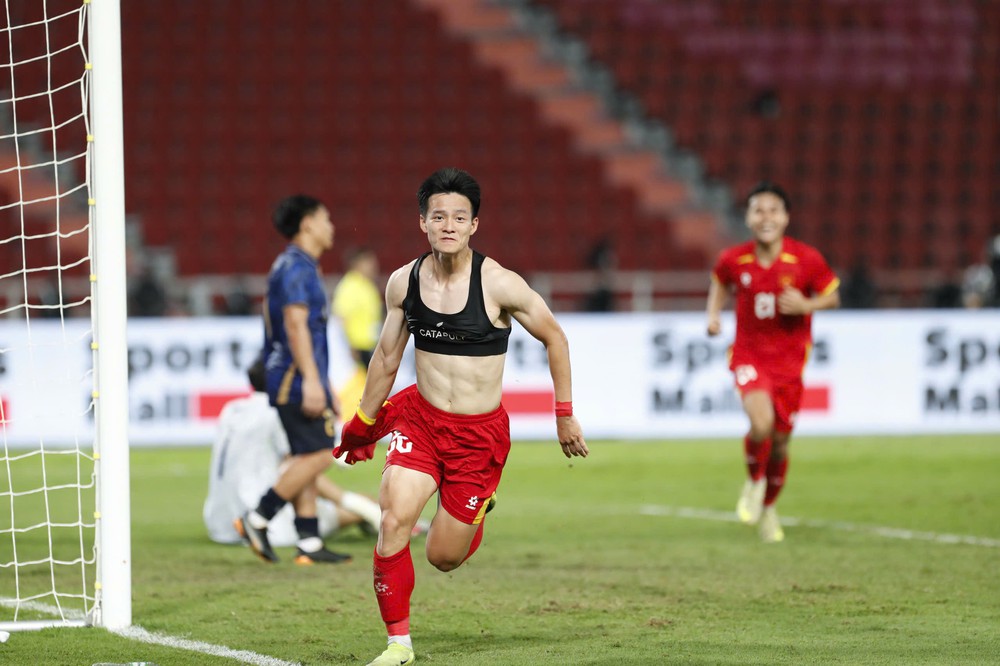
Thanh Nhàn is one of the U23 "veterans" added to the Vietnamese U21 team for the Asian Games. Photo: Tuấn Phạm
But with the U23 Asian Cup shifting to a four-year cycle, and Vietnamese U23s now dominating Southeast Asia, opportunities for continental competition at this age group have become scarce. The 20th Asian Games, featuring 11 of Asia's 20 strongest football nations, offers a rare chance for competitive exposure. The initial decision to send the U21 team was to seize this opportunity for growth, building a squad for the 2027 SEA Games in Malaysia, and further ahead for the 2028 U23 Asian Cup finals (a ticket to the Los Angeles Olympics), and even the 2034 World Cup dream.
In other words, whether or not additional U23 veterans are included, the Asian Games—a quadrennial event with relatively low performance pressure—should still be used to develop the next generation. At this age, players rarely get international matches (apart from Southeast Asian U23 tournaments) and find it hard to break into club first teams or the national squad. Therefore, maintaining a majority of U21 players in the Asian Games squad remains the more "natural" approach.
While the naturalization policy is being pushed forward for the national team to serve the near-term goal of World Cup qualifiers just two years away, the Asian Games is a story of long-term domestic strength. What happened after the 19th Asian Games showed that selecting players below the allowed age limit was a reasonable choice. This remains a challenge that requires persistence and a willingness to take risks.


Wonderfulshortvideo

raphinha assist today lamine yamal goal today brace today vs levante



Follow for more pokemon content! So what do I do with them now?…

arda guler assist today guler vs rayo vallecano mbappe goal today jude bellingham goal today

Cristiano Ronaldo and Al Nassr vs Al Khaleej

HIGHWAYMAN WINS THE BETFRED ST LEGER! 🏆

DESERT CASTLE DOMINATES! 🏆🍾

mbappe ballon d'or interview lequipe mbappe edit mbappe interview
 Links
Links
 Contact
 App
App


