



Alcaraz reaches the semifinals amid controversy over electronic device confiscation in the previous round; manufacturer responds: This is not steroids



In today’s Australian Open men’s singles quarterfinal, Alcaraz defeated De Minaur 7-5, 6-2, 6-1 to advance to his first Australian Open semifinal! Yet, despite the on-court celebration, debate continues off court due to the previous match incident where the chair umpire demanded he take off his Whoop smart band.

Here’s what happened: In the previous round, the men’s singles fourth round, during warm-up, chair umpire Marija Cicak noticed a device hidden under Alcaraz’s wrist sweatband. After a brief discussion, the umpire asked Alcaraz to remove the device, and he complied without protest.
It is reported that the device was a Whoop fitness tracker—a screenless wearable that monitors recovery, energy expenditure, sleep, and physical activity, while syncing with other devices to analyze heart rate and blood oxygen levels.

The incident was caught by television cameras and broadcast worldwide, prompting renowned tennis commentator Mark Page to state during the commentary: “Whoop watches or any devices monitoring vital signs are not allowed here.”
Notably, Alcaraz is not alone. Defending champion Sinner was also found by umpire Greg Allensworth to be wearing a smart monitoring device hidden under his sweatband during his fourth-round match against Darderi. Additionally, reports claim that women’s world No. 1 Sabalenka was asked to remove her tracker before her first-round match.

The core of this controversy lies in inconsistent rules across tournaments. The International Tennis Federation (ITF) has approved Whoop devices for use during matches, and players are allowed to wear them on ATP and WTA tours. However, Grand Slam regulations prohibit any wearable smart devices that can transmit data during matches unless specially authorized, to prevent risks related to “information transfer, external coaching, or betting integrity.” This discrepancy causes confusion and debate as top players face differing device policies across events.
As a Whoop ambassador, Sabalenka has called on Grand Slam organizers to reconsider the ban, expressing confusion: “I wear it during matches because we received an email from the ITF approving the device. Throughout the year, we use Whoop on the WTA tour just to monitor my health.”

Sinner accepted the rule: “Rules are rules, I understand, and I won’t wear it again. The chair asked me if it was a monitoring device, I said yes, and he told me to take it off.” He explained that athletes want to collect some data on court mainly for post-match analysis.
Former Australian tennis champion Lleyton Hewitt sharply criticized the ITF’s approach: “I don’t know what the ITF is doing these days. They messed up the Davis Cup, and now this.” He questioned, “It makes no sense when you can use it on the WTA tour.”
Nine-time Wimbledon doubles champion Todd Woodbridge also shared similar frustration: “They worry you might get coaching from it. But we already have coaching! Why can’t you have your own data? I don’t understand these rules.”

As the debate heated up, a statement from the Whoop founder saying “data is not steroids” further fueled intense online discussions.
The Whoop CEO responded today to the Australian Open ban on Alcaraz wearing the device: “Absurd! Whoop has been approved by the ITF for use in matches and poses no safety risk. Let athletes measure their bodies. Data is not steroids! (Referring to the previous Sinner doping case).”
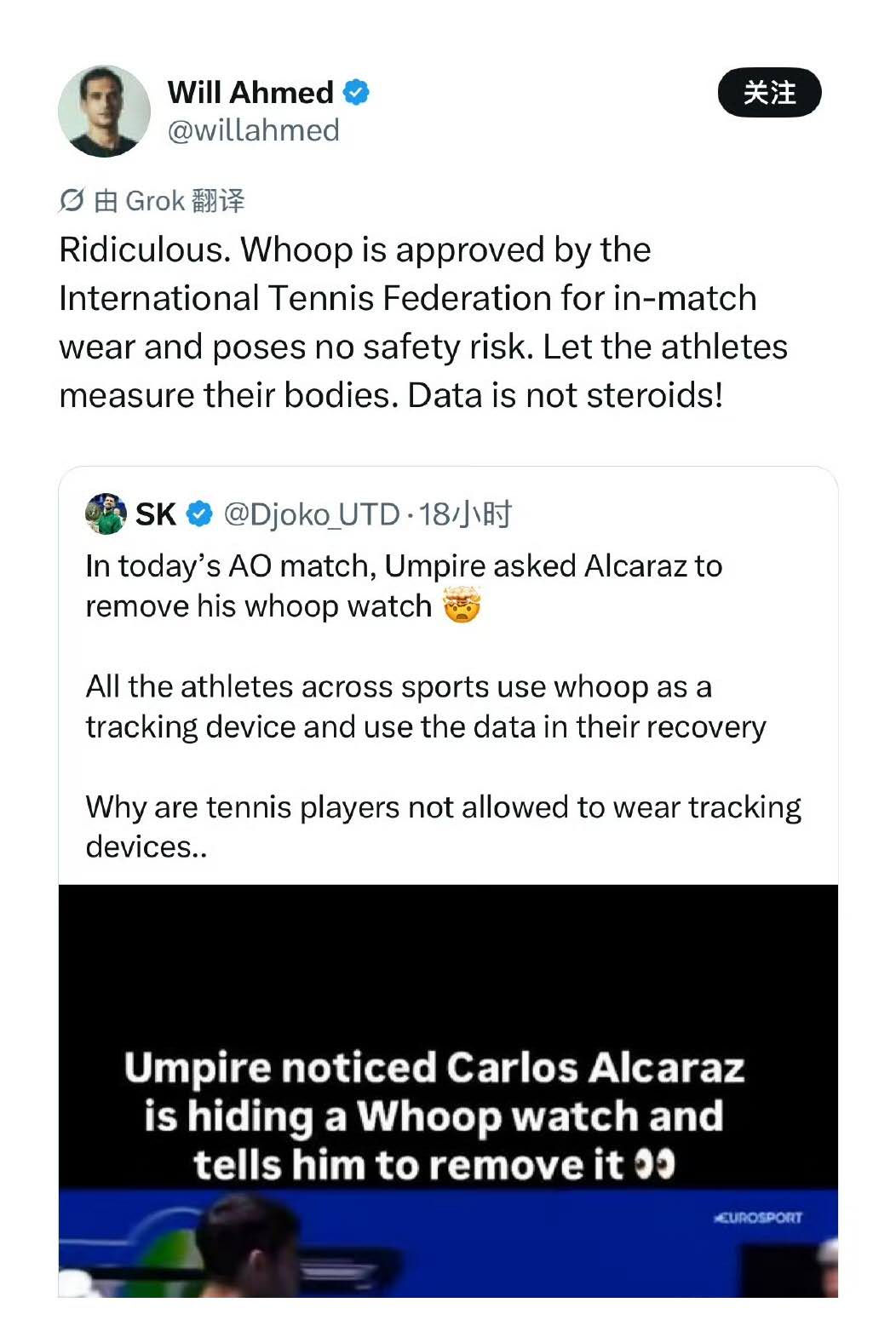
Some netizens were unhappy with the analogy, feeling it inappropriate to compare health data to doping, but most discussion focused on the “double standard” in rule enforcement.
However, some sharply pointed out: “This is obviously ridiculous! The standards for rulings are biased! Imagine if Djokovic wore a non-permitted wearable device, he would likely have been defaulted.”
In fact, athletes have reasons to insist on using such devices. In the high-intensity world of professional tennis, precise physical data monitoring is a key part of scientific training. World No. 2 Sinner explained their purpose: “These are data we want to use in training too, like heart rate, calories burned, etc.” He emphasized the data is mainly for post-match analysis, not real-time coaching.

For top players like Alcaraz, understanding their body’s responses, recovery status, and energy consumption patterns during demanding Grand Slam events helps optimize match strategies and recovery plans.
Facing this controversy, Tennis Australia confirmed: “Wearable devices are currently not allowed at Grand Slam events. The Australian Open is in ongoing discussions about how to change this situation.” This suggests possible rule adjustments.

Whoop maintains its product stance in a statement: “Whoop believes athletes have the right to understand their performance and health, including at events like the Australian Open.” They added, “Preventing access to personal health data does not protect sports.”
This controversy highlights the clash between traditional sports regulations and technological progress. As wearable technology becomes more widespread, sports governing bodies must balance maintaining fair competition with allowing athletes access to personal health data. The rapid advancement of sports technology is changing how athletes train and compete, and finding ways to ensure fairness without hindering performance enhancement and health protection will be a shared challenge for global sports organizations.(Source: Tennis Home Author: Lu Xiaotian)

 Links
Links
 Contact
Address:UNIT 1804 SOUTH BANK TOWER, 55 UPPER GROUND,LONDON ENGLAND SE1 9E
Number:+85259695367
E-mali:[email protected]
 App
App


