



The curtain has fallen on the Australian Open and its suspense; the battle for the 2026 season has only just begun.



On February 1, 2026, with the conclusion of the Australian Open men’s singles final, many of the pre-tournament uncertainties of the year’s first Grand Slam were finally resolved.
Progress of current male and female Grand Slam champions toward achieving a career Grand Slam.
According to previous participation records, both Swiatek and Alcaraz, each with six Grand Slam titles, were just one Australian Open victory away from completing a career Grand Slam, but neither had previously reached the Australian Open final. Last year, Swiatek missed a match point in the Australian Open semifinals, and this year she was defeated by Rybakina in a tough quarterfinal battle, temporarily slowing her pursuit of a career Grand Slam; meanwhile, Alcaraz, who exited in the quarterfinals last year, persevered this year to claim the title, becoming the youngest male player in history to complete a career Grand Slam at 22 years and 272 days old. At the same time, another suspense emerged: Sinner, who holds four Grand Slam titles, has already won three different types of Grand Slam trophies — the Australian Open, Wimbledon, and the US Open — and last year reached three championship points in the French Open final, missing the title by just one point. Although Sinner trails Alcaraz in total Grand Slam wins, his higher efficiency raises anticipation about whether he can follow Alcaraz’s footsteps and complete a career Grand Slam this year at Roland Garros. We eagerly await the outcome.

2. Outstanding performances from popular and strong contenders
Sabalenka, a two-time tournament champion and three-time Grand Slam finalist, was naturally a strong contender for the Australian Open title. Since the 2024 US Open, Sabalenka has consistently reached at least the semifinals in Grand Slams. Unfortunately, she lost last year’s Australian Open final to the surging Keys and was also affected by the “Brisbane law,” which suggests that players winning the Brisbane 500 event often fail to win the Australian Open. This year, Sabalenka successfully defended her Brisbane title, and interestingly, she has reached the Australian Open final four times, winning twice and finishing runner-up twice, seemingly influenced again by the Brisbane victory.
On the men’s side, despite advancing age, 38-year-old veteran Djokovic remains active on the Grand Slam stage. Djokovic, who once dominated the Australian Open with 10 titles, has maintained strong competitiveness over the past two years, reaching the Australian Open semifinals in both 2024 and 2025. This year, benefiting from the withdrawals of Menchik and Musetti in consecutive rounds, Djokovic advanced relatively smoothly to the semifinals, where he fought a five-set battle against defending champion Sinner, saving 16 of 18 break points to reach the final. Although he lost the final 1-3 to Alcaraz, Djokovic’s record of reaching 11 finals and winning 10 titles at the Australian Open demonstrates that he still has the strength to compete at the highest level.
With the conclusion of the Australian Open, ATP and WTA rankings have shifted somewhat. Djokovic, boosted by the points gap between the runner-up and semifinalist, overtook Zverev to claim third place, while Sabalenka retained her runner-up points without change, continuing her tenure as world number one. For Sabalenka, maintaining deep runs in Grand Slams and competing for titles remains an obvious goal, while for Djokovic, it is about continuing his beloved tennis career and seeing how far he can go.
3. Gains and regrets on the court
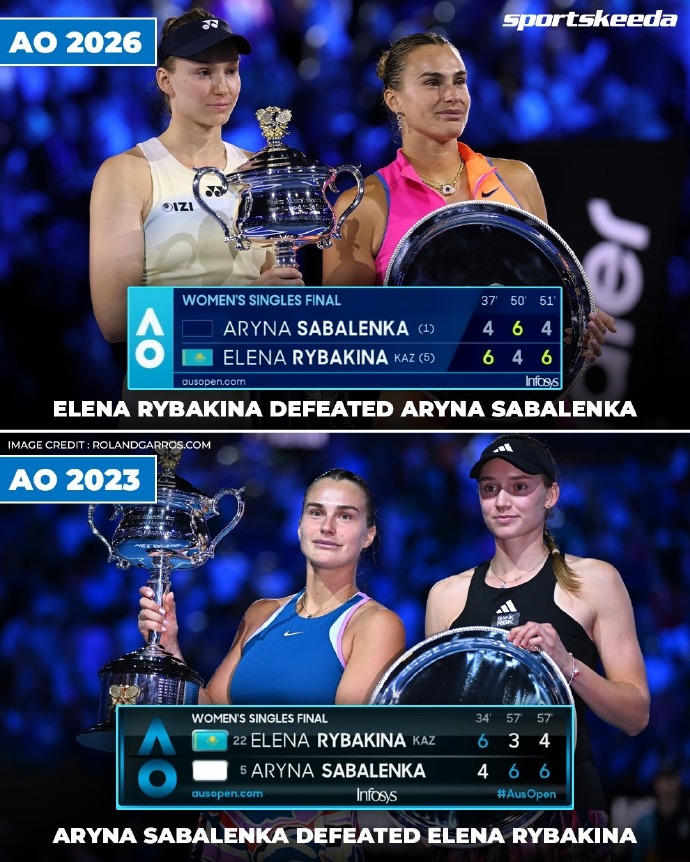
Starting from last year’s Ningbo 500 event, Rybakina went on a winning streak, overtaking Mira Andreeva in points to secure a spot in the year-end finals, where she won five consecutive matches to claim the highest single-event prize money. At the start of the new year, Rybakina, seeded fifth at the Australian Open, consecutively defeated top-ten players Swiatek, Pegula, and Sabalenka from the quarterfinals onward, ultimately capturing her second Grand Slam trophy. Similar to the paths of Mauresmo and Wozniacki, who won year-end championships before claiming Grand Slam titles, Rybakina’s world ranking rose to third. From winning Wimbledon four years ago to reaching another Grand Slam final three years ago, Rybakina has now claimed the trophy that eluded her three years prior. Currently, she trails world number two Swiatek by less than 400 points. Whether she will rest after this Grand Slam victory or continue to build momentum in the upcoming Middle East tournaments in February and the Sunshine double events in March remains to be seen.
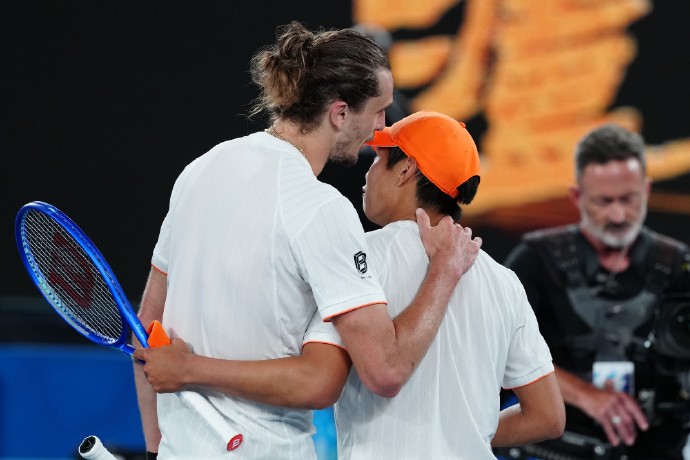
If Rybakina’s triumph freed her from the “one-Grand Slam wonder” label and marked a career breakthrough, Zverev’s repeated setbacks were the biggest disappointment of this Australian Open. Having reached three Grand Slam finals but never winning a title, even his Tokyo Olympic gold has had little impact. This Australian Open marked his tenth Grand Slam semifinal appearance. Despite cramps against Alcaraz and holding a match point on his serve in the deciding set, Zverev lost a grueling 5-hour 27-minute battle. It’s not that Zverev lacks the ability to win, but as Italian legend Bertolucci bluntly put it, he “lacks the heart of a champion.”
4. The Chinese team delivered solid performances and surprises
Since Li Na’s retirement in September 2014, Chinese tennis has entered a “post-Li Na era.” At the 2015 Australian Open, thanks to the persistence of veterans, the Chinese contingent reached the round of 16 in singles and finished runner-up in doubles, with Zheng Jie and her partner from across the strait lasting until the end.
At the 2026 Australian Open, with the highest-ranked Zheng Qinwen sidelined by injury, Bai Zhuoxuan, returning from injury, engaged in a thrilling long-set battle against veteran Pavlyuchenkova in the first round, and her second-round match against world number one Sabalenka was also noteworthy.
On the men’s singles side, Shang Juncheng and Wu Yibing defeated Agut and Nardi respectively to advance to the second round. Shang matched his best personal Australian Open result, while Wu’s progress marked a positive return from injury.
In women’s singles, Wang Xinyu reached the fourth round after consecutive wins over Kalinina, Ostapenko, and Noskova. Although she lost 6-7, 4-6 to another Grand Slam finalist, Anisimova, she achieved her goal of reaching the second week of a Grand Slam.
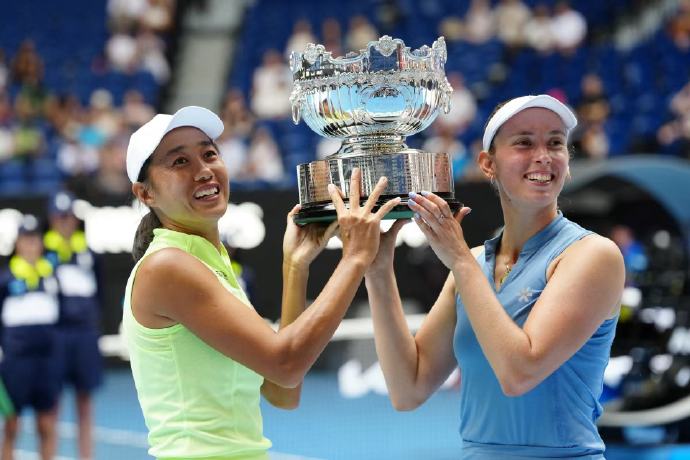
Most remarkably, veteran Zhang Shuai proved her enduring strength by winning her third Grand Slam women’s doubles title alongside Mertens, after victories at the 2019 Australian Open and 2021 US Open. This legendary accomplishment, echoing a similar feat eleven years ago, saw the veteran stand strong until the very end of the Grand Slam tournament.
The Chinese team experienced ups and downs throughout 2025, facing many challenges. With over nine months of tour remaining after the 2026 Australian Open, this women’s doubles title could boost the morale of Chinese tennis. Let us look forward to hearing more victorious news as the tour resumes in February.(Author: Jiang Dong Dabaiyu; Source: Tennis Home)

 Links
Links
 Contact
Address:UNIT 1804 SOUTH BANK TOWER, 55 UPPER GROUND,LONDON ENGLAND SE1 9E
Number:+85259695367
E-mali:[email protected]
 App
App


