



Ten key adjustments you need to make when switching from singles to doubles



Shifting from singles to doubles tennis involves more than simply having an additional player on the court. Although the core principles of tennis stay consistent, doubles requires distinct mental attitudes, skill sets, and tactical approaches. Players who perform well in singles often struggle at first in doubles since success depends less on solo control and more on cooperation, court movement, and communication.
If you are moving from singles to doubles, understanding the essential adjustments will help you become a more effective and dependable partner, while maximizing your strengths within a team setting.

2026 Australian Open Men’s Doubles Champions: C. Harrison / N. Skupski
1. Shift your mindset from solo play to team collaboration
In singles, every point is entirely dependent on your own decisions and execution. In doubles, responsibility is shared. This mental shift is one of the most crucial changes you must make.
You need to learn to trust your partner’s abilities and accept that you won’t hit every ball. Trying to “do it all” often leads to poor positioning, overhitting, and unforced errors. Successful doubles players focus on consistency, smart shot selection, and creating opportunities for their partner rather than trying to score alone.
Key mindset changes include: (1) prioritizing teamwork over individual highlight shots; (2) embracing shared wins and losses; (3) encouraging or comforting your partner after mistakes to maintain their confidence.
2. Enhance communication and signaling
Communication plays a minimal role in singles but is vital in doubles. Clear and consistent communication helps prevent confusion, missed balls, and positioning errors.
Before each point, partners should discuss: (1) serve placement; (2) net movement patterns; (3) volley intentions (poaching); (4) return positioning.
Using hand signals behind the back before serving is common in doubles, and quiet verbal cues can also be used. These signals indicate whether the net player will stay put, poach, or fake movement. During the rally, verbal calls like “mine” or “yours” help avoid collisions and hesitation.
Another important aspect is that strong doubles teams communicate calmly and constructively, especially after losing points.
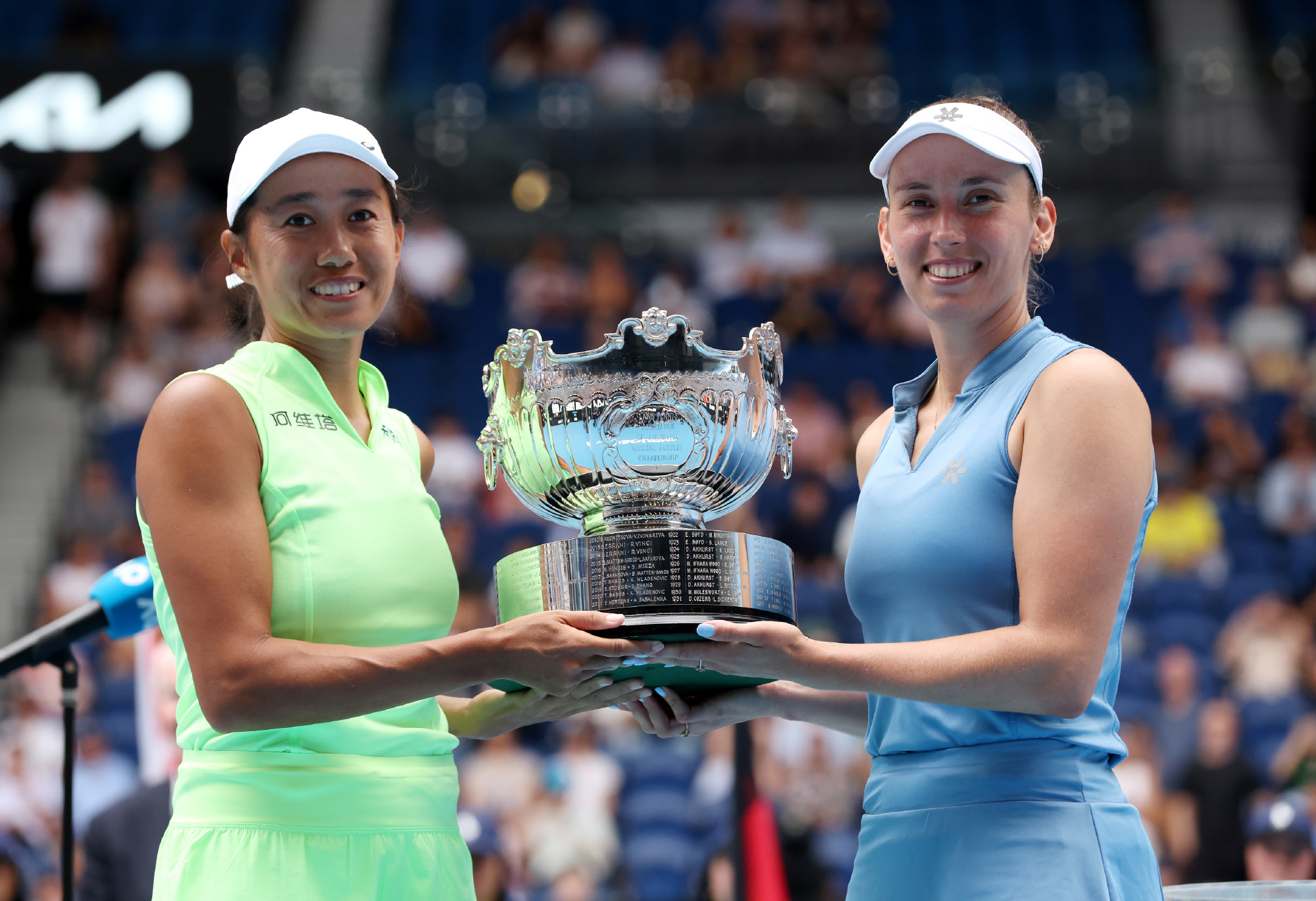
2026 Australian Open Women’s Doubles Champions: Zhang Shuai / Elise Mertens
3. Adjust your court positioning and movement
Singles players are used to covering the entire court. In doubles, the court coverage is divided, and positioning becomes tighter and more strategic.
The most common doubles formation places one player at the net and one at the baseline. This setup allows the team to control the net area, a critical advantage in doubles. Singles players often stand too far back or shift unnecessarily toward the middle, giving opponents better angles.
Important positioning adjustments include: (1) moving closer to the net at appropriate times; (2) coordinating lateral movement with your partner instead of moving independently; (3) maintaining proper spacing to cover crosscourt shots and lobs.
Good doubles positioning reduces the need for large movements and improves reaction times.
4. Improve your net play skills
Net skills are far more important in doubles than in singles. Singles rallies often happen from the baseline, but many points in doubles are decided at the net.
If you are transitioning from singles, you may need to develop: (1) volley technique; (2) reaction speed; (3) net awareness; (4) consistency under pressure.
In doubles, volleys don’t require power but demand precise placement. Targeting open spaces or forcing difficult returns is more effective than trying to finish points outright. Practicing quick reactions, volley accuracy, and pressure shots will significantly boost your doubles competitiveness.

2026 Australian Open Mixed Doubles Champions: Gadecki / Peers
5. Modify your serving strategy
In singles, serves are often used to win points outright, while in doubles, the main goal is to set up your partner at the net.
This means focusing on: (1) first serve consistency; (2) placement and trajectory over speed; (3) serving wide or body serves to limit aggressive returns.
Also, a reliable second serve is crucial because double faults are more costly in doubles due to shorter rallies and higher pressure.
Considering your partner’s position during your serve can create easier volley opportunities and quick points.
6. Optimize your return of serve
Doubles return strategies differ significantly from singles. The goal is often not to win the point outright but to neutralize the server’s advantage and avoid the net player.
Effective doubles returns include: (1) low shots at the net player’s feet or deep angled returns; (2) lobs over an aggressive net player to give your partner time to poach.
Singles players must resist the temptation to blindly hit risky down-the-line shots unless a clear opportunity arises. Stability and placement are far more valuable than speed.

2026 Australian Open Junior Boys’ Doubles Champions: Doig / Kissimov
7. Learn poaching and anticipation skills
Poaching is a hallmark doubles technique where the net player crosses the court to intercept the opponent’s return or baseline shot.
Singles players may find this challenging at first because poaching relies on anticipation rather than simple reaction. Observing your opponent’s body language, grip changes, and shot habits helps improve timing.
Even fake poaches (moving without hitting) can pressure opponents into errors.
Poaching transforms passive net defense into aggressive offense, making it harder for opponents to predict your moves.
8. Choose shots wisely and control risks
In singles, taking high-risk shots can be justified if it helps you control the rally, but in doubles, unnecessary risks often harm the team.
Smart doubles players: (1) favor crosscourt shots more often; (2) avoid low-percentage down-the-line winners; (3) use lobs strategically rather than just defensively.
In doubles, consistency and patience outweigh pure power. Forcing opponents to hit extra shots increases their chance of errors under pressure.

2026 Australian Open Junior Girls’ Doubles Champions: A. Kovachikova / J. Kovachikova
9. Master doubles-specific tactics
Doubles tennis includes unique tactics rarely seen in singles, such as: (1) the Australian formation; (2) the I-formation; (3) planned poaching; (4) serve-and-volley combinations.
Learning when and how to use these tactics adds variety to your game and prevents opponents from settling into predictable patterns.
Watching professional doubles matches or partnering with experienced players can accelerate your tactical understanding.
10. Build strong chemistry with your partner
Unlike singles, doubles success heavily depends on the rapport between partners. Playing styles, strengths, and weaknesses should complement each other.
A good partnership is based on: (1) mutual respect; (2) honest and supportive feedback; (3) clearly defined roles.
The most common doubles pairing is one player strong at the net and the other solid from the baseline. Recognizing and leveraging these differences creates a balanced and effective team.

Promotional poster for 2026 Australian Open Women’s Doubles Champions Zhang Shuai / Mertens produced by the tournament organizers
Conclusion
Switching from singles to doubles tennis requires not only technical skills but also adaptability, communication, and a team-oriented mindset. By adjusting your positioning, enhancing net play, refining shot selection, and learning doubles-specific tactics, you can become a confident and reliable doubles player.
Players who think strategically, trust their partners, and prioritize consistency over personal glory tend to win more matches. Embracing these changes will not only improve your doubles performance but also deepen your overall understanding of tennis.(Source: Tennis Home, Author: Yun Juan Yun Shu)

 Links
Links
 Contact
Address:UNIT 1804 SOUTH BANK TOWER, 55 UPPER GROUND,LONDON ENGLAND SE1 9E
Number:+85259695367
E-mali:[email protected]
 App
App


