



Twenty years ago today: The Hawk-Eye system was born, becoming a landmark event in tennis transformation.



On March 6, 2006, the USTA, ATP, and WTA jointly announced the introduction of Hawk-Eye electronic line-calling technology into professional tennis tournaments, along with the corresponding player challenge rule. Shortly after, the 2006 Miami Open became the first tournament to implement this rule.
Throughout tennis history, misjudgments, incorrect overrules, and disputes between players and officials have never ceased. Except for the ball marks left on clay courts, the point of impact on hard and grass courts is fleeting. In most cases, the line judge's call is final, and players must accept it even if they disagree.
Logically, the players on the court are the closest observers to the ball's landing spot. Line judges positioned near the baseline or the chair umpire have a greater distance and a limited viewing angle, making them less than ideal for determining whether a ball is in or out. However, professional tournaments require neutral, specialized officials, while many amateur matches operate on an honor system.
For officials, no matter what measures are taken to continuously refine their professional skills, mistakes can never be entirely avoided. Once a player or the audience questions a call, they face immense pressure.
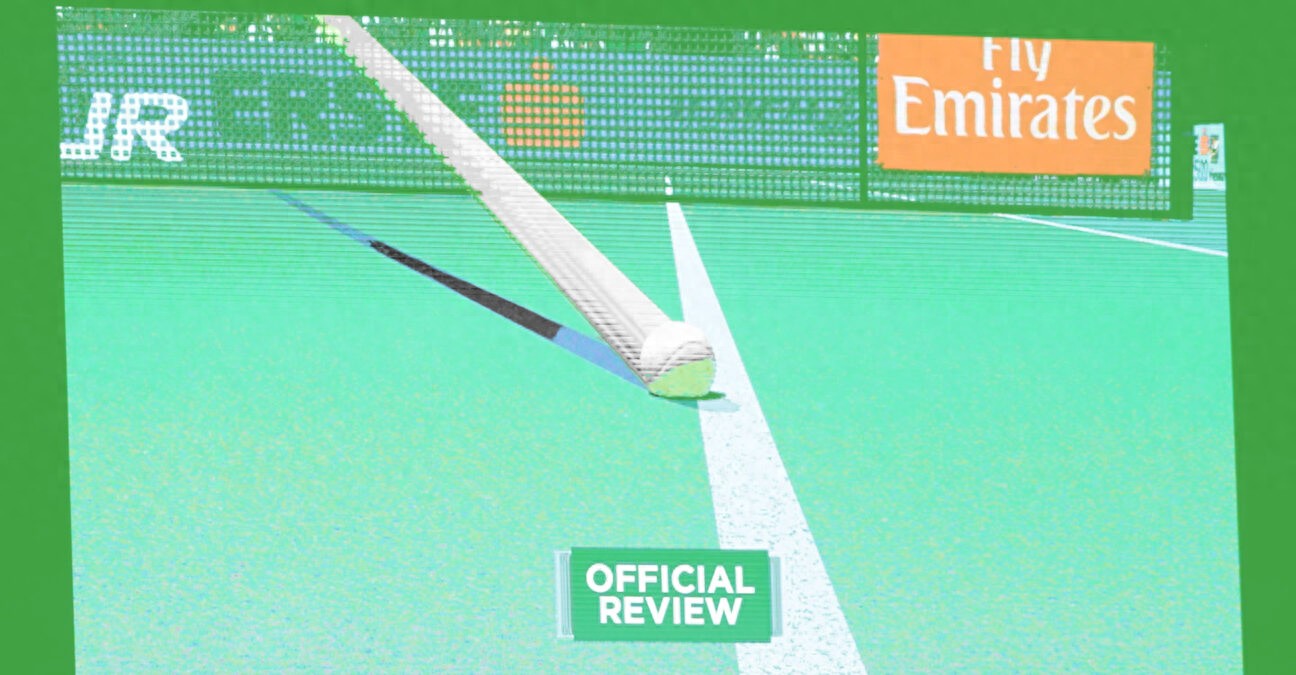
For this reason, research into using machines to replace humans began early, with attempts to invent electronic line judges to take over from human ones. In 1979, the world's first electronic line judge, "Cyclops," was introduced. It debuted at Wimbledon in 1980 and subsequently became widespread in most tennis tournaments (except on clay). At that time, this system could only judge whether a serve was out; it could not determine baseline calls because player movement near the baseline interfered with its operation.
In 1999, Paul Hawkins invented the Hawk-Eye system based on this technology. Initially, it was used only for television broadcasts, replaying the ball's landing point when a controversial call occurred on court. Since this function was solely for TV, the live audience, players, and officials could not see the replay, so it had no direct impact on the actual officiating.
Several subsequent controversial incidents accelerated the adoption of electronic line-calling technology. The most famous was a women's singles quarterfinal at the 2004 US Open, where Serena Williams lost to Jennifer Capriati, with several clear misjudgments occurring at crucial moments. The US Open officially apologized to Serena Williams afterward, and the involved official was banned from officiating the remainder of that year's tournament.
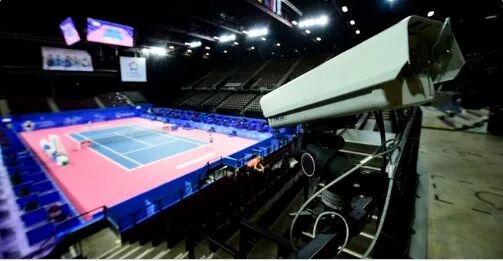
This incident drew more attention and reflection, leading to a growing consensus within the industry—the Hawk-Eye system could effectively resolve endless disputes between players and officials.
On March 6, 2006, Arlen Kantarian of the USTA, Larry Scott of the WTA, and Etienne de Villiers of the ATP jointly announced the introduction of the Hawk-Eye system in select North American tournaments.
Then WTA Chairman and CEO Larry Scott stated: "As followers of the sport, we have all seen matches turn due to controversial calls that were later proven incorrect by TV replays. Today's tennis tournaments carry so much weight; we must do everything possible to use technology to ensure accurate calls while preserving the human element of on-court officiating."
Alongside introducing Hawk-Eye, tennis governing bodies simultaneously established the challenge rule, granting players two opportunities per set to challenge a line judge's call. If the challenge is successful, the opportunity is retained for continued use within the set; if unsuccessful, it is forfeited.
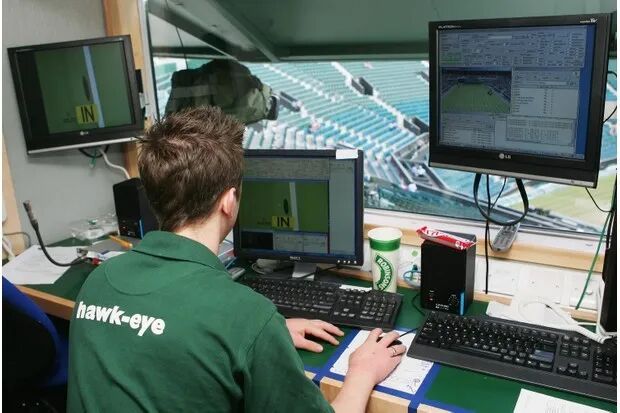
The decision to introduce Hawk-Eye and update the rules accordingly received widespread support. Andre Agassi remarked, "In my 20-year professional tennis career, this is one of the most exciting changes for players, fans, and television viewers." John McEnroe, known for frequent disputes with officials, said, "Anyone who has heard my commentary over the past year knows I've always supported introducing replay technology. I believe it makes tennis more interesting."
However, there were also opposing voices. Tennis superstars of the time, Roger Federer and Rafael Nadal, publicly opposed the new technology. For instance, Federer commented, "This is simply ridiculous, a pure waste of money."
Nevertheless, supportive opinions held an overwhelming advantage. Hawk-Eye technology and the challenge rule were trialed as scheduled at the Miami Masters, and the US Open that year became the first Grand Slam to adopt the rule.
At the 2006 Miami Open, American player Jamea Jackson became the first to use the Hawk-Eye system, initiating a challenge during her first-round match against Ashley Harkleroad. Although the challenge was unsuccessful, she later said, "I love this system; it's really great and significantly reduces the mental pressure on players."
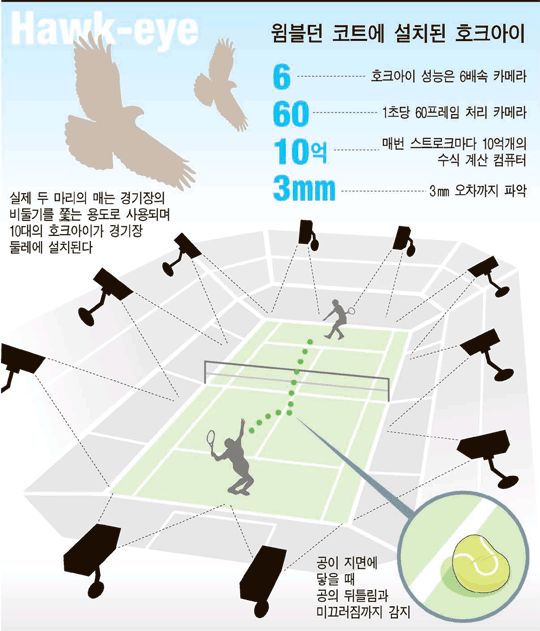
Now, twenty years later, the Hawk-Eye system has become standard in most tours except on clay. The primary reason it hasn't been adopted in clay-court tournaments, including the French Open, is the presence of ball marks on clay, and the fact that the ball often scatters the surface upon impact. Some argue that Hawk-Eye's simulated mark cannot accurately determine whether the ball was out. Additionally, there are instances where players believe officials have pointed to the wrong mark, leading to far more disputes on clay than those surrounding Hawk-Eye's introduction.
This is not to say the Hawk-Eye system is completely error-free. In reality, any machine can have bugs and is prone to mistakes. There have indeed been cases where Hawk-Eye system failures prevented replays.
Therefore, the debate over whether to introduce Hawk-Eye and whether it should entirely replace human line judges is fundamentally ideological. For example, some believe that French Open officials occasionally climbing down to inspect ball marks, and the occasional disputes between officials and players, actually add flavor to the game. If officials never made mistakes, or if machines completely replaced them, tennis matches might become less interesting.
What is your view on this issue? Feel free to leave a comment below.(Source: Tennis Home, Author: Yun Juan Yun Shu)

 Links
Links
 Contact
Address:UNIT 1804 SOUTH BANK TOWER, 55 UPPER GROUND,LONDON ENGLAND SE1 9E
Number:+85259695367
E-mali:[email protected]
 App
App


