



From the Australian Open to the U.S. Open, will Terry implement a best-of-five sets format for women's events at this year's U.S. Open?


This year's Australian Open was likely the most successful tournament ever, with attendance, public interest, revenue, and player prize money all reaching historic highs.
Furthermore, throughout his 13-year tenure, Terry consistently brought forth new ideas, leading to the great success of the Australian Open Grand Slam. This marks advancement for the Australian Open and for tennis globally.
After the Australian Open concluded, tournament director Terry, as rumored, accepted an offer from the United States Tennis Association (USTA) to become its Chief Executive Officer across the ocean. In this role, Terry will focus on promoting tennis in the United States and oversee another Grand Slam event—the U.S. Open.
Crossing the ocean, Terry quickly adapted to his new position and proposed an ambitious vision: to increase the number of tennis participants in the U.S. from 27 million to 35 million by 2035. To achieve this vision, Terry outlined his long-term mission and current responsibilities with "three major goals and four S's."

For the USTA, Terry set "three major goals": to encourage more Americans to pick up a racket and play tennis; to help top American players perform at their best; and to upgrade tournament platforms, using the U.S. Open and other professional events to drive the sport's development.
Regarding the U.S. Open, Terry believes the current priority is enhancing the spectator experience, summarized by "four S's": Screens, Seats, Shade, and Space. Terry explained, "By focusing on these four aspects, fans will be very satisfied."
Industry observers see Terry's "three major goals" as ambitious and challenging, while the "four S's" he currently emphasizes are concrete measures. The former represents grand ideals, the latter practical efforts to achieve them.
Terry's approach is straightforward: make the U.S. Open better, attract more spectators, generate greater influence, and then the "three major goals" will naturally follow.
This is Terry's consistent style. Such a decisive and swift approach has also faced controversy.
During his 13-year leadership of the Australian Open, Terry implemented a series of bold innovations: adding a roof to Margaret Court Arena; introducing electronic line-calling systems; increasing prize money from 20 million AUD in 2007 to 115 million AUD this year; extending the tournament duration from two weeks to three weeks or longer; creating the "One Shot" event and establishing "Fan Week"; introducing bars and live performances at Melbourne Park.
These bold moves also brought criticism. Traditionalist fans did not accept these expansions and the lively atmosphere, feeling the Australian Open had become "too big and too noisy."

This year, a video of Coco Gauff smashing her racket sparked discussions about player privacy protection. Players complained about too many cameras around the courts, leading to a small protest. But Terry remained unmoved, believing all disputes could be resolved through dialogue, and that his decisions must be executed—such as lowering ticket prices to attract fans and allowing spectators to move between games rather than only during changeovers.
For Terry, while players' rights deserve respect and protection, the fan experience is more crucial and must always be prioritized.
Based on these principles, Terry's initiatives yielded tangible results. Australian Open attendance doubled in just ten years, from 700,000 in 2016 to 1.4 million this year.
With people and popularity, expanding tennis' influence and increasing participation becomes a natural outcome—the ultimate goal for tennis organizations worldwide.
Over 13 years, Terry transformed the Australian Open from "the little brother of Grand Slams" to "the leader of Grand Slams." Compared to the slowly developing French Open and traditionally conservative Wimbledon, the Australian Open's innovation and progress are evident. In many aspects, it has surpassed the historically older French Open and Wimbledon.
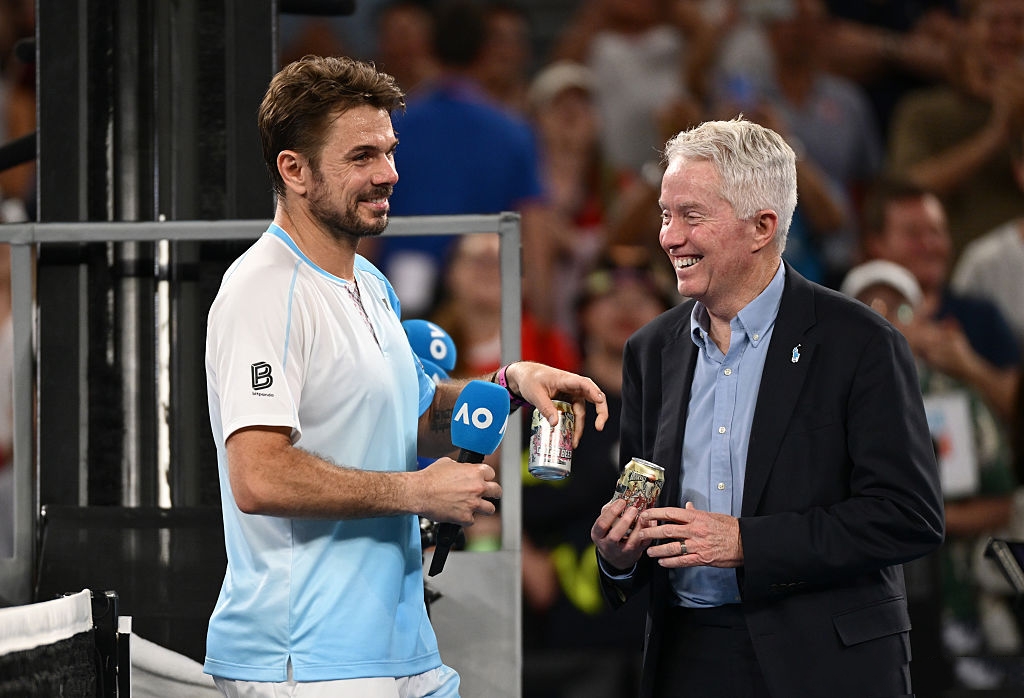
But compared to the U.S. Open, the Australian Open still lacks full confidence.
Among the four Grand Slams, the U.S. Open has always led with advanced innovation and high commercial appeal. Flushing Meadows in New York boasts the world's largest tennis stadium; the U.S. Open has the most fans globally and the most lively, spectator-friendly atmosphere. For years, its prize money and revenue have steadily grown.
It can be said the U.S. Open is already highly developed. Terry, known for expansion, now faces the challenge of driving faster growth. Similar to how Ferrero brought Alcaraz to the top, a subsequent coach inevitably faces immense pressure.
This is the difficult situation Terry currently confronts.
When hiring Terry, the USTA set this KPI for him: by 2035, have 35 million Americans participate in tennis, currently at 27 million.
“This is a challenging goal, but the path is clear. Only by working together and avoiding distractions can we achieve it,” Terry said after signing the contract.
Achieving ambitious goals quickly often requires a strong leader with decisive power, visionary insight, and resolute methods.
Terry is precisely such a person.
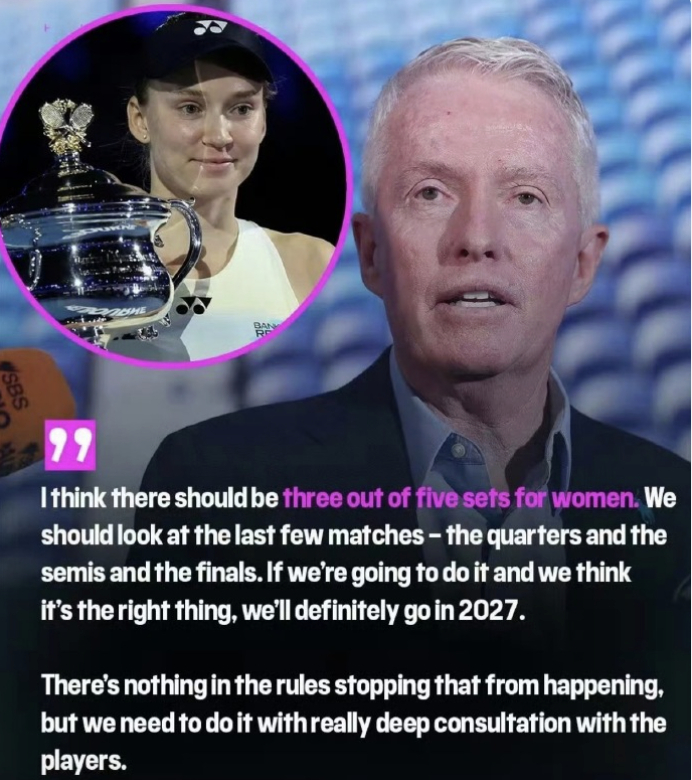
Now, with five months until the U.S. Open begins, we eagerly await to see what changes and surprises Terry will bring. Currently, the most intriguing expectation is whether Terry will, as he suggested before leaving the Australian Open, introduce a best-of-five sets format for women's singles after the quarterfinals?(Source: Tennis Home, Author: Yun Juan Yun Shu)

 Links
Links
 Contact
Address:UNIT 1804 SOUTH BANK TOWER, 55 UPPER GROUND,LONDON ENGLAND SE1 9E
Number:+85259695367
E-mali:[email protected]
 App
App


