



Online fans compare the slow-motion forehand of Anwa and Medvedev, revealing many thought-provoking insights.



Recently, online users compared the forehand techniques of Russian rising star Andreeva and top male player Medvedev, sparking widespread discussion.

From this short video, distinct differences in their preparation phases can be observed. In the footage, Andreeva’s forehand preparation starts from one side of her body, accompanied by a pronounced “straight up and down” large motion—the racket lifts from waist level to above the shoulder, then drops before swinging to the contact point. Throughout this process, the arm swing is extensive, nearly vertical in trajectory, and includes a noticeable “dropping of the racket head.”

Unlike Andreeva, Medvedev’s preparation is more concise, or rather more compact. His forehand preparation almost begins directly from the chest, with the racket head pointed diagonally upward toward the court, not lifted too high, and staying closer to the body. The racket moves within a small range. The benefit is immediate: the racket reaches the hitting position in the shortest time, then drives through the ball horizontally, without a clear “dropping of the racket head.” Overall, Medvedev’s stroke appears more efficient and streamlined, with no superfluous “fluctuation.”
While it is often said that men’s and women’s tennis are two different sports, the underlying principles reflected in this comparison deserve contemplation.
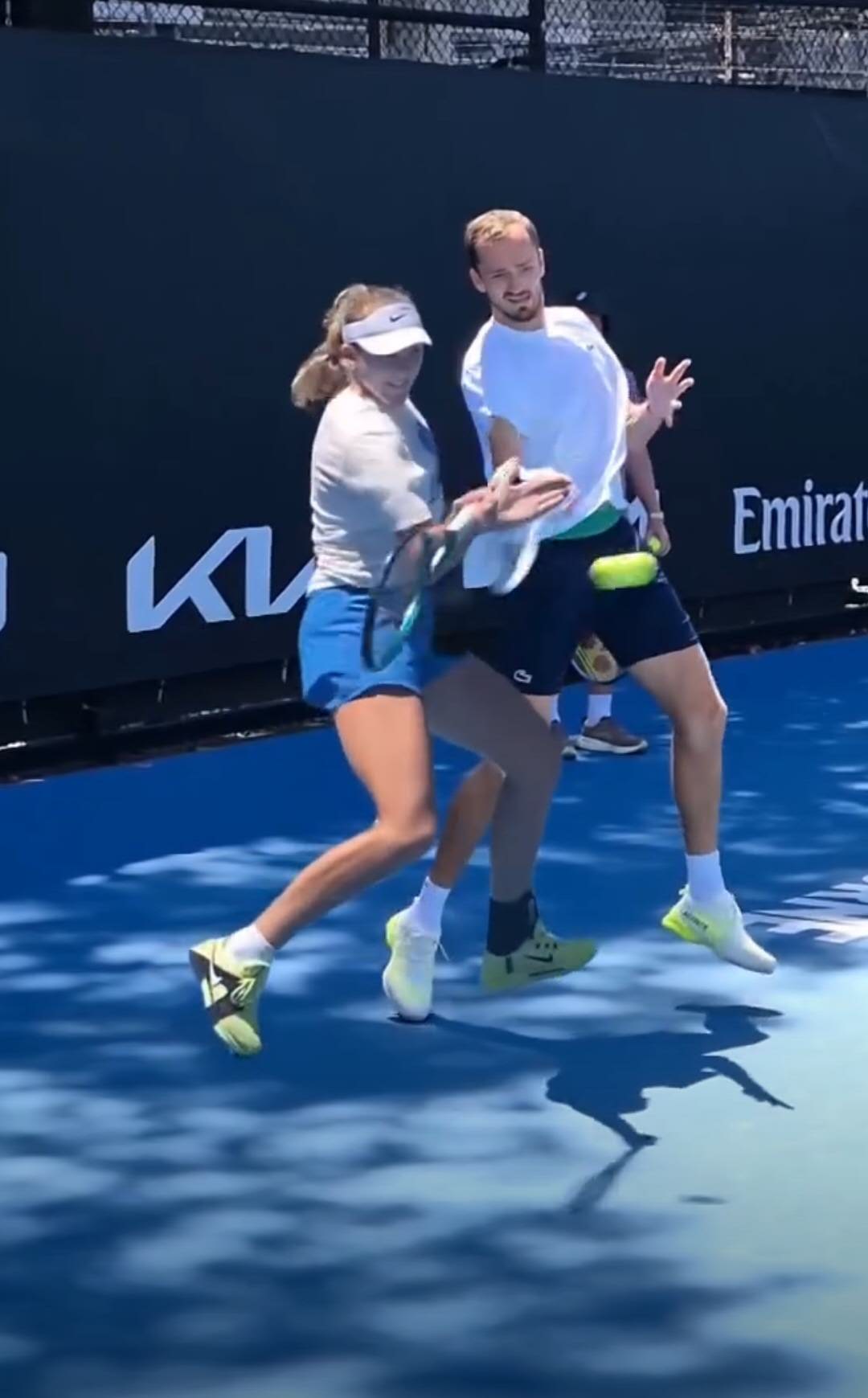
Conventional thinking suggests that male players generally possess greater muscular strength, allowing them to generate sufficient ball speed and spin with a compact preparation while conserving time for quicker recovery to prepare for the next shot. Female players, with relatively less power, traditionally rely more on a larger preparation to “store energy” to ensure shot quality, but this also leads to slower initiation and delayed continuity.
However, in today’s tennis landscape, with the enhanced core strength and explosiveness of female players, their speed is no longer inferior to male players, a point demonstrated in the mixed-team United Cup over the past two years.

Yet the issue remains that compared to male players, female players often lag in action stability, mental resilience, shot control, and spin—this constitutes the core distinction between men’s and women’s tennis. This was evident in last year’s classic “battle of the sexes”: although Kyrgios’s form had declined among male players, his superior mental toughness and consistency in baseline strokes still allowed him to dominate the women’s world number one, Sabalenka.
But our discussion extends beyond the differences between men’s and women’s tennis; more importantly, it concerns the reasons behind these disparities.
Looking at today’s tennis, being “faster,” having more “spin,” and greater “stability” have become essential core competitive advantages. Ten years ago, even if you were under 170cm tall and lacked explosive power, you could still participate in the sport. The reason was that tennis then emphasized “technical play”; matches often hinged on “tactics deciding everything.” You didn’t need exceptional endurance or powerful strokes; you needed the most rational shots and cost-effective ways to win points quickly!

However, over time, as players in the new era routinely serve over 200 km/h, and the spin intensity and angle variation of baseline shots far exceed those of ten years ago, relevant calculations show that in today’s high-intensity duels, players often have less than 0.5 seconds to react. Ten years ago, this figure was 1.5 seconds. What does this mean? Modern tennis relies almost on “subconscious” reactions and muscle memory, preventing controlled “judgment” during strokes.
Medvedev’s compact preparation technique is precisely for adapting to this “millisecond-level confrontation”—by shortening the preparation path, he can complete his stroke faster, even quickly changing direction in defensive situations. The women’s game is also accelerating; top players like Sabalenka and Swiatek have noticeably reduced their forehand preparation compared to predecessors like Sharapova and Henin, aiming to enhance rhythm control in extended exchanges.
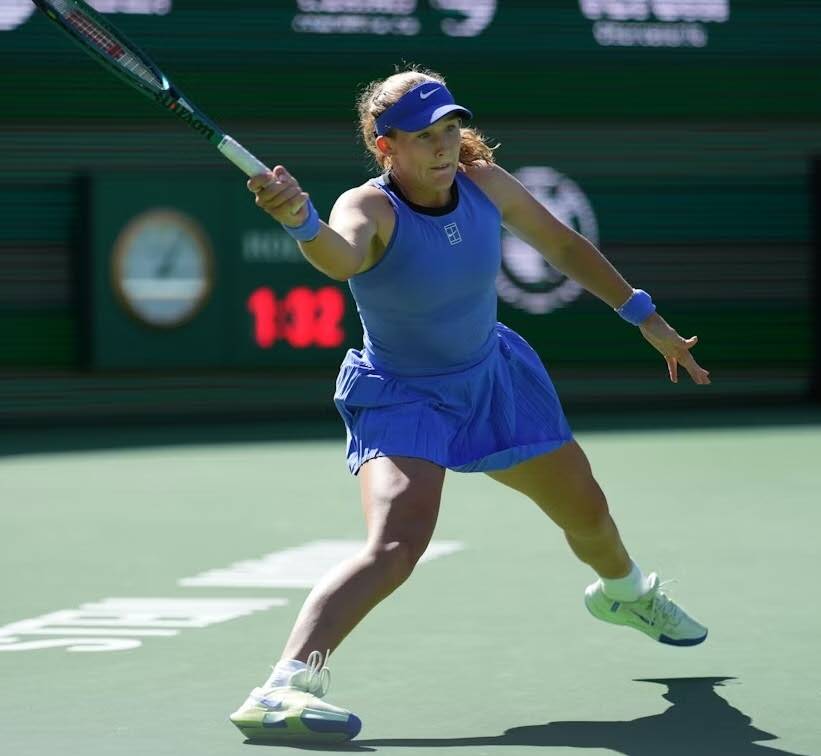
Compared to the “golden era” of ten years ago, this technical evolution is clearer. Federer’s forehand preparation was much larger than Medvedev’s; he relied more on a whip-like wrist action and full-body coordination to produce aesthetically pleasing and powerful shots. Nadal’s “Nadal spin,” though remarkable in rotation, involved a far greater “pull-back” of the left arm and swing range of the right arm than today’s compact preparation. Matches then were relatively slower; court speed and racket technology hadn’t yet intensified competition to a “white-hot” level, allowing players ample time to build tactics with larger preparations, thus fostering more distinct individual styles.
Now, younger players must also adjust their preparation techniques to suit the new era. During winter training in 2023, Alcaraz specifically modified his forehand preparation from a somewhat “overhead” large motion to a more compact “short and flat” trajectory, directly improving his continuity speed in extended rallies by 15%. Sinner also reduced his forehand preparation last year, cutting 30% of unnecessary movement, making baseline transition smoother. For them, a compact preparation isn’t “sacrificing individuality” but using more efficient motions to respond to modern tennis where “every shot cannot be slow.”

Additionally, Chinese player Wang Xinyu, after her breakthrough at this year’s Australian Open, highlighted adjustments to her backhand during winter training—actively reducing her preparation by about 15%. The effect was immediate: her backhand defensive capability greatly improved at the Australian Open, and her baseline fluency became smoother.
Returning to the comparison between Andreeva and Medvedev, this isn’t just a technical difference between two players but reflects the sport’s shift from “power accumulation” to “quick continuity.” As the pace in women’s tennis continues to accelerate, perhaps soon we’ll see more female players, like Alcaraz and Sinner, adjusting their preparation to “save time and boost efficiency.” After all, in increasingly fast modern tennis, “speed” remains the constant truth.(Source: Tennis Home Author: Lu Xiaotian)

 Links
Links
 Contact
Address:UNIT 1804 SOUTH BANK TOWER, 55 UPPER GROUND,LONDON ENGLAND SE1 9E
Number:+85259695367
E-mali:[email protected]
 App
App


