



Who is the most powerful ATP forehand player?丨Data analysis based on TDI



In the previous two articles, we analyzed the serving and returning quality of ATP players based on the TDI indicator system.
Today, let's focus on the forehand. This article will use the forehand indicators within the TDI system to measure and analyze who possesses the strongest forehand among ATP players.
1. What indicators does TDI set for the forehand, and how do they differ from traditional forehand data?
In tennis matches, the forehand is a player's most essential and relied-upon offensive weapon—whether for follow-up after a serve, breakthroughs in extended rallies, or winning shots in baseline exchanges. The forehand often determines the direction of a point and even the outcome of the match.
For casual viewers, when evaluating a player's forehand during a match, they might only say "the forehand has great power," or "the forehand is very stable," and "the forehand can produce winning shots." Occasionally, simple metrics like "forehand scoring rate" are mentioned, but they cannot clearly explain "where exactly his forehand strength lies" or "why his forehand can produce winning shots."
Similar to the serving and returning indicators, the forehand indicators in the TDI system completely break the limitations of traditional forehand data, creating a "comprehensive, detailed" forehand evaluation tool.
The core differences between TDI forehand indicators and traditional forehand data mainly lie in three aspects: First, traditional data only counts results like "forehand points won, forehand winners," while TDI considers both results and the quality and tactical choices of the forehand stroke itself. Second, traditional data is coarse-grained, looking only at single-match or season aggregates, whereas TDI can precisely detail every forehand stroke. Third, traditional data has weak practical utility, only useful for summarizing performance, while TDI can directly guide players to improve their forehand technique in targeted ways.

A brief interjection: Alcaraz posted on his personal social media yesterday, showing a kangaroo tattoo on his left ankle to commemorate his Australian Open victory this year. Thus, Alcaraz has now collected all four Grand Slam-specific tattoos: Statue of Liberty (US Open), Brooklyn Bridge (US Open), strawberry (Wimbledon), Eiffel Tower (French Open), kangaroo (Australian Open).
2. The three core categories of forehand indicators, covering "process-result-strategy"
The first category is the Forehand Quality Index (FSQ), which measures "how threatening this forehand stroke is." It is the core of forehand indicators, unrelated to forehand scoring outcomes, focusing solely on the quality and threat level of the forehand stroke itself. The scoring range is 0-10, with higher scores indicating a more threatening forehand stroke. It is calculated primarily based on six core dimensions: forehand stroke speed, spin intensity, contact point selection (rising, peak, descending), placement accuracy, ball bounce trajectory, and match context, comprehensively assessing the technical level of each forehand stroke.
For a simple example: Both players make a forehand return. Player A's stroke is fast, with strong spin and precise placement near the line, directly pressuring the opponent. Player B's stroke is slow, with weak spin and shallow placement, allowing the opponent to easily counterattack. Then Player A's FSQ score will be much higher than Player B's, illustrating the gap in forehand quality.
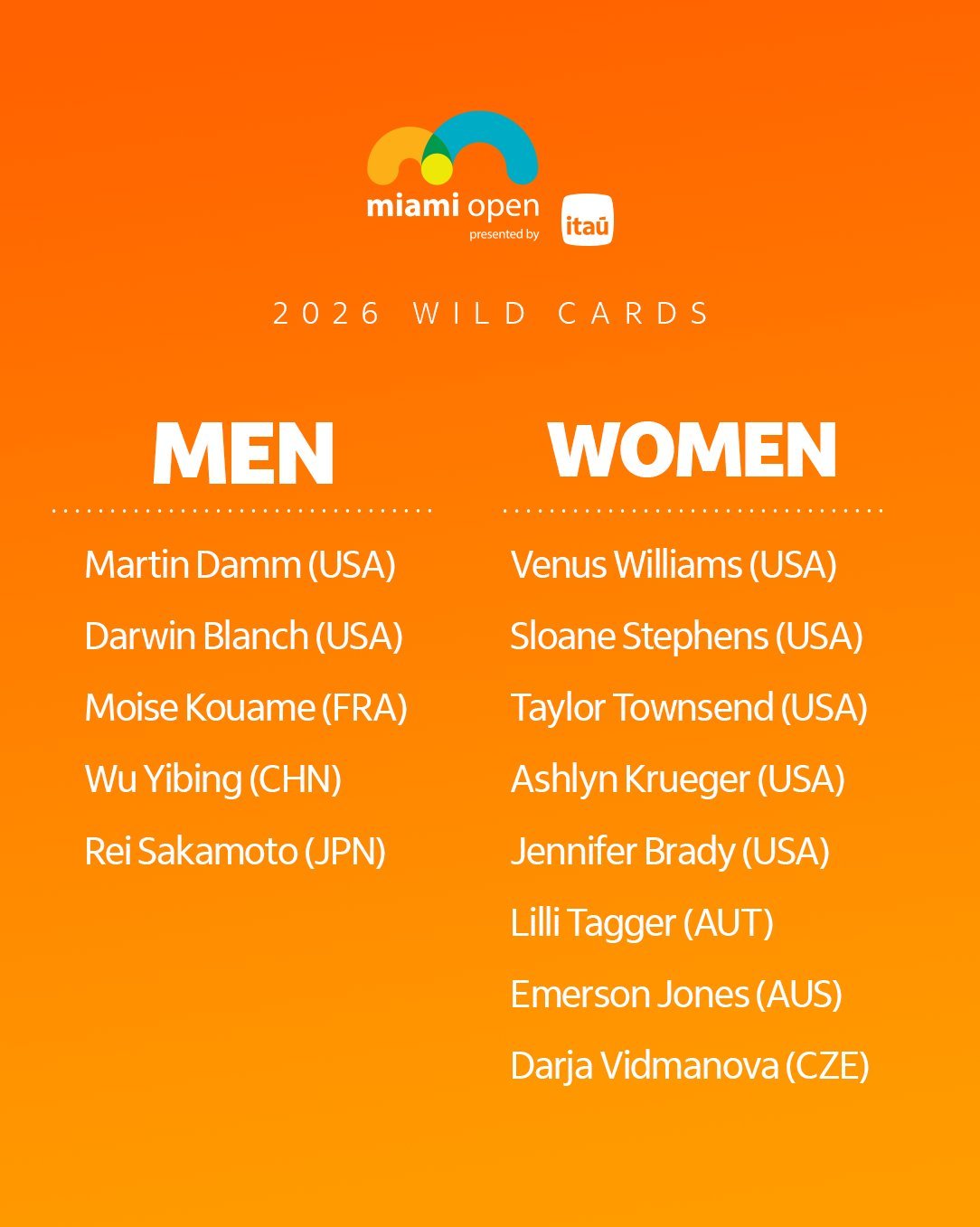
A brief interjection: Wu Yibing received a wildcard entry into the main draw of the ATP 1000 Miami Open. The second leg of the "Sunshine Double," the Miami Masters, begins tonight at 11 PM Beijing time.
The second category is the Forehand Efficiency Index, which measures "whether the forehand can convert into points or advantages." This is a "result-oriented" indicator, presented as percentages. Its core function is to see if forehand quality translates into points or advantages. It interacts with the forehand quality index, explaining "why some players have high forehand quality but low scoring rates."
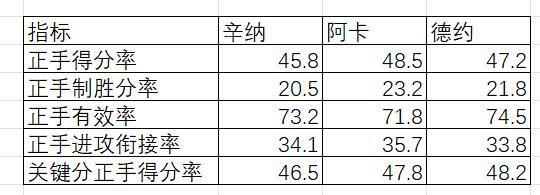
The second category includes the following five core indicators: (1) Forehand Scoring Rate: The proportion of forehand rallies where the point is won; higher indicates stronger forehand scoring ability. (2) Forehand Winner Rate: The proportion of forehand strokes that directly win the point (excluding forehand winners after serves); reflects the finishing ability of the forehand. (3) Forehand Effectiveness Rate: The proportion of forehand strokes that successfully return the ball and do not give the opponent a direct attacking opportunity; reflects the stability of the forehand. (4) Forehand Attack Follow-up Rate: The proportion of forehand strokes that immediately initiate continuous attacks and gain initiative; reflects the follow-up ability after a forehand. (5) Forehand Scoring Rate on Key Points: The scoring proportion in forehand rallies during key point situations (game point, set point, match point); reflects forehand stability under pressure.
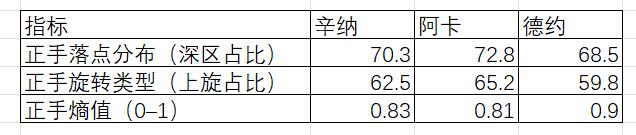
The third category is the Forehand Tactical Distribution Index, which bridges forehand quality and efficiency, explaining why with similar forehand quality, some players score more and others less. It focuses on a player's forehand tactical choices and diversity. Core indicators include: (1) Forehand Placement Distribution: The proportion of forehand returns landing in different areas of the opponent's court (inside corner, outside corner, midcourt, deep zone); reveals the player's forehand tactical emphasis. (2) Forehand Spin Type Distribution: The proportion of forehand returns by spin type (topspin, sidespin, flat, slice); more spin variation makes it harder for opponents to predict. (3) Forehand Entropy: Measures the unpredictability of forehand placement and spin; higher entropy means more diverse forehand choices, making it harder for opponents to prepare specifically.
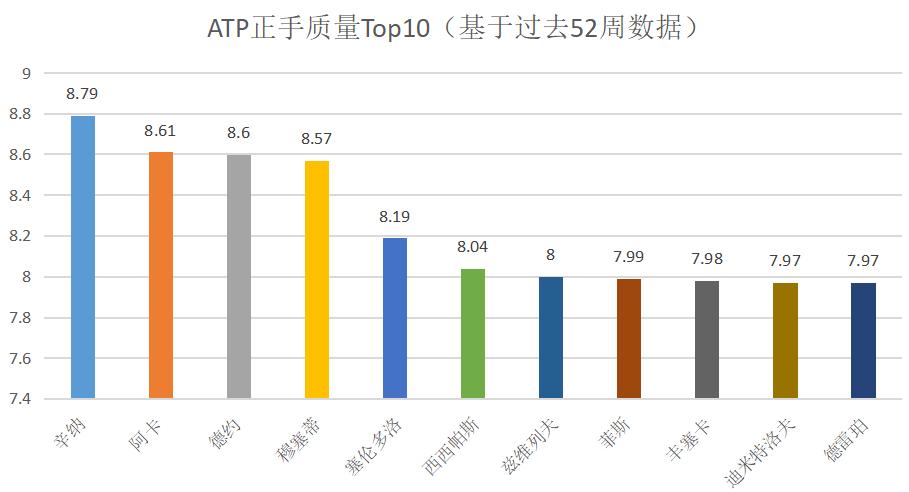
Based on the above three categories of indicators, ATP has listed the Top 10 Forehand Quality rankings over the past 52 weeks, as shown in the figure below.
3. Comparative analysis of forehand quality indicators for Sinner, Alcaraz, and Djokovic
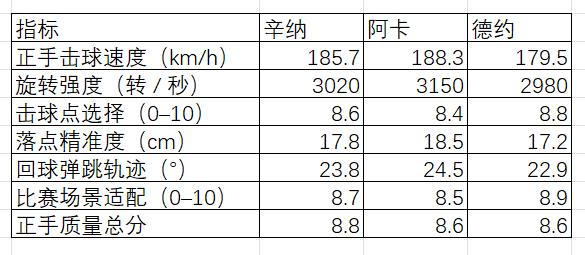
Combining ATP's publicly available data over the past 52 weeks, we again take Sinner, Djokovic, and Alcaraz as examples, comparing their TDI forehand core indicators to summarize the differences in their forehand styles.
1. Forehand Quality Index
2. Forehand Efficiency Index
3. Forehand Tactical Distribution Index
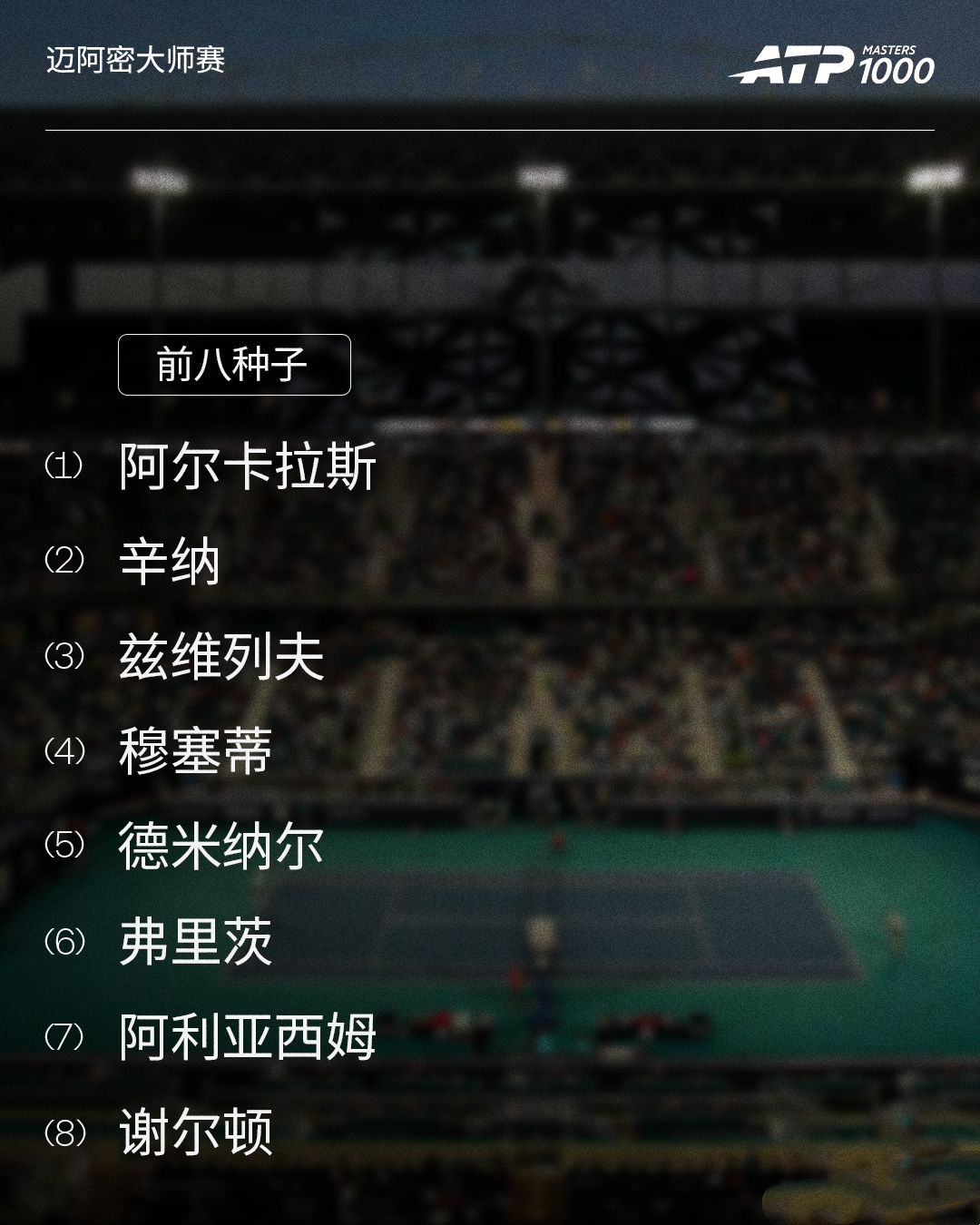
A brief interjection: In the Miami Masters qualifying final round, Bu Yunchaokete lost a 4-1 lead in the deciding set, falling 3-6 6-3 5-7 to Ferri. Huang Zelin lost 2-6 6-3 3-6 to Buse. Both failed to directly enter the main draw.
Through the above three categories of indicators, aided by AI, we can analyze the forehand characteristics of these three players.
(1) Quality dimension: Sinner has the highest total FSQ score, with balanced speed, spin, and placement; Alcaraz has the strongest speed and spin, highlighting aggressive attributes; Djokovic has the best contact point and context adaptation.
(2) Efficiency dimension: Alcaraz leads in forehand scoring rate and winner rate, possessing the strongest finishing ability; Djokovic has the highest forehand effectiveness rate and key point scoring rate, demonstrating top-tier stability; Sinner shows balanced efficiency across all aspects, with smooth transitions.
(3) Tactical dimension: Alcaraz has the highest proportion of deep zone and topspin shots, showing the strongest offensive aggression; Djokovic has the highest entropy, with the most tactical variations, making him difficult to predict; Sinner has precise placement and spin control, with balanced tactical choices.(Source: Tennis Home Author: Yun Juan Yun Shu)

 Links
Links
 Contact
Address:UNIT 1804 SOUTH BANK TOWER, 55 UPPER GROUND,LONDON ENGLAND SE1 9E
Number:+85259695367
E-mali:[email protected]
 App
App


